الوصف
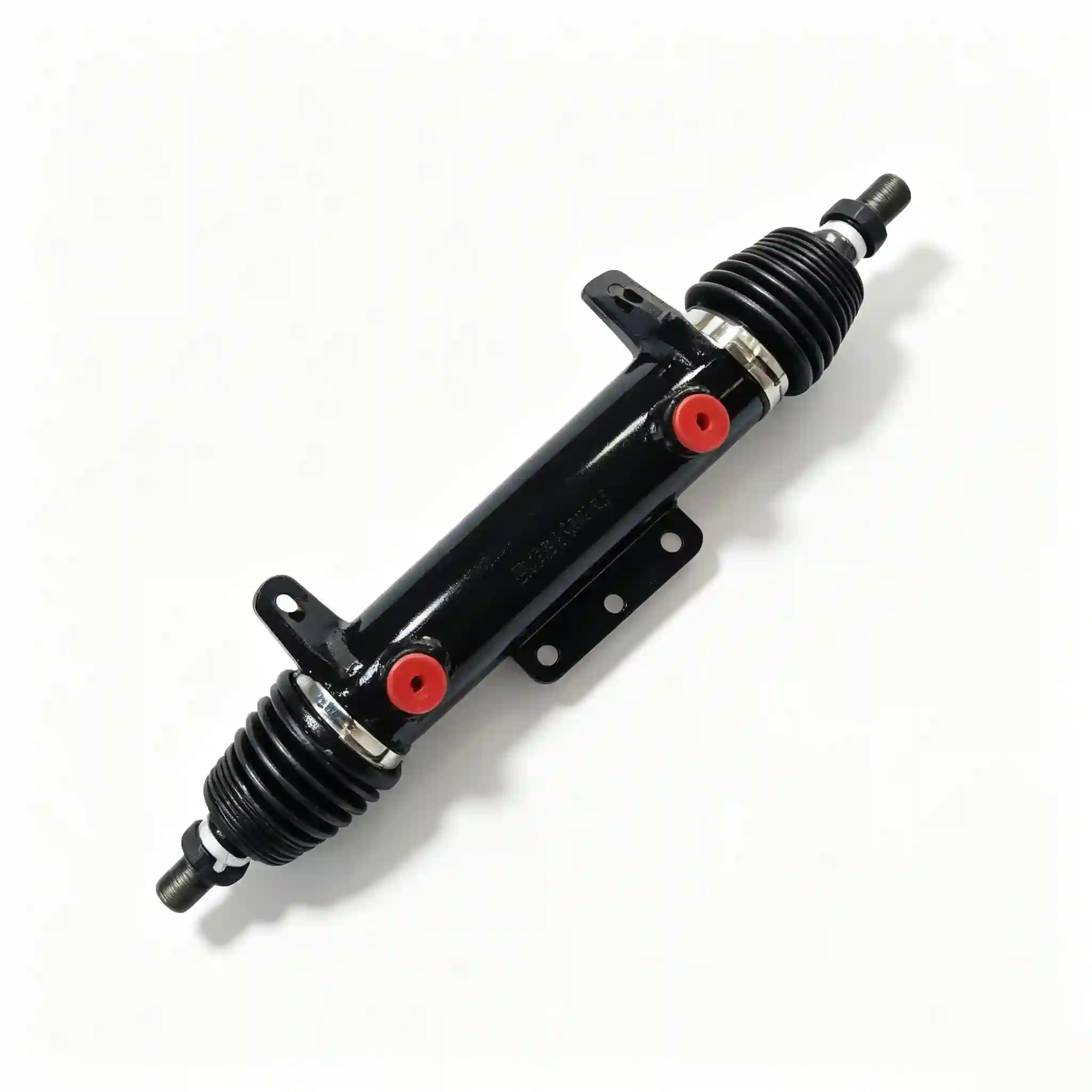
Split-Type Tractor Power Steering Cylinder for Ningbo Front Axle — 50 mm Bore × 135 mm Stroke Dual-Body Hydraulic Steering Ram
| Product Type | Split-Type (Dual Cylinder Body) |
| Bore Diameter | 50 mm |
| Rod Diameter | 25 mm |
| Stroke (per body) | 135 mm |
| Mounting Distance (C-C) | 495 mm |
| Axle Compatibility | Ningbo-Standard Front Axle |
| Cylinder Configuration | Double-Acting, Split-Mount |
| Seal Material | PU Primary + NBR Backup |
Enquire for OEM / Fleet Supply
Ningbo axle fitment verified · MOQ 10 units · FOB Ningbo
Engineering Overview: Split-Type 50 mm Bore Hydraulic Steering Cylinder Purpose-Built for Ningbo Front Axle Mounting Architecture
The Split-Type Tractor Power Steering Cylinder for Ningbo Front Axle is a structurally distinct product within the agricultural hydraulic steering cylinder category. Unlike conventional single-body telescopic or tie-rod cylinders that mount at two points—one barrel end and one rod end—this split-type design uses two separate cylinder bodies, each contributing half of the total steering force and displacement, mounted symmetrically on either side of the front axle beam centreline. This configuration is the factory-standard steering arrangement for tractors built around the Ningbo-pattern front axle, a widely adopted axle design produced in the Ningbo region of Zhejiang Province, China, and used across a substantial portion of Chinese-manufactured compact-to-mid-range tractors exported globally.
The split-type architecture delivers three engineering advantages over a single-cylinder arrangement on the Ningbo axle. First, it distributes the total steering force symmetrically about the axle centreline, eliminating the lateral bending moment that a single off-centre cylinder would impose on the axle beam. Second, it reduces the per-cylinder bore requirement: each cylinder needs only to generate half the total required steering force, allowing a 50 mm bore to serve applications that a single-cylinder design would require a 63–70 mm bore to satisfy. Third, it permits a more compact installed package in the axle envelope, since two shorter cylinders—each with a 135 mm stroke—occupy less longitudinal axle space than a single cylinder with the equivalent combined travel would require.
With a 50 mm bore and 25 mm rod, this cylinder fits the mid-weight tractor segment—typically 40–70 hp machines where the Ningbo front axle design is most commonly specified. The 135 mm stroke per body, combined with the symmetric dual-mount geometry, delivers an effective steering arm sweep that achieves the design lock-to-lock wheel angle without requiring long lever arm lengths at the steering knuckle. For fleet operators and OEM procurement teams, the replacement procedure requires sourcing matched pairs of identical cylinders—left-hand and right-hand bodies—since installing mismatched cylinders with differing bore wear states or seal conditions produces asymmetric steering effort that manifests as a persistent steering pull toward one side.
This cylinder is the correct replacement part for Ningbo-axle-equipped tractors across multiple Chinese tractor brands that share the Ningbo platform, including machines widely distributed in Australia, Brazil, South Korea, and the Netherlands under various private-label or distributor-brand designations. The 495 mm C-C mounting distance is specific to the Ningbo axle beam geometry and should be confirmed against the existing installation before ordering.

Hydraulic Performance Data: 50 mm Bore Operating Pressure, Force Output, and Dual-Cylinder Flow Balance for Symmetric Steering Response
Each cylinder body in this split-type assembly has a bore area of 1,963 mm² and a rod area of 491 mm² (based on the 25 mm rod). The bore-to-rod area ratio is 4.0:1—notably higher than in single-cylinder steering rams—because the rod diameter is intentionally kept at 25 mm to minimise the rod displacement volume differential between the two circuit branches. In a split-type system, both cylinders share the same hydraulic circuit, with the rod-end of one body connected in series or parallel with the barrel-end of the other, depending on the specific circuit topology. Maintaining a consistent rod area across both bodies ensures that the hydraulic flow balance between left-turn and right-turn manoeuvres remains equal, which is a prerequisite for symmetric steering effort throughout the lock-to-lock range.
At a typical operating pressure of 12 MPa, each cylinder body generates an extension force of approximately 23.6 kN. The combined two-cylinder system therefore delivers 47.2 kN total steering force—equivalent to what a single 70 mm bore cylinder at the same pressure would produce—confirming that the split-type design achieves its force target through quantity rather than bore enlargement. For the retract stroke (rod-end pressurisation), each cylinder produces approximately 17.7 kN, yielding a combined retract force of 35.4 kN. The 47.2 / 35.4 kN extend/retract asymmetry is intentional, as the heavier force direction aligns with the primary turning resistance encountered by the loaded front axle under field conditions.
The barrel tube for this cylinder is manufactured from 20# seamless precision steel tubing with an internal honing finish of Ra ≤ 0.4 µm. The 50 mm bore is checked with an air plug gauge at three axial positions along the 135 mm stroke. Given the shorter 135 mm stroke length relative to the bore diameter (stroke-to-bore ratio of 2.7:1), the risk of bore taper is lower than in long-stroke cylinders, but honing consistency is still critical because any diameter variation along the stroke range causes the piston seal to experience alternating compression and relaxation cycles that fatigue the seal lip at a faster rate than uniform bore compression would.
The 25 mm piston rod is produced from 45# carbon steel, induction hardened to 55–60 HRC surface hardness and hard chrome plated to 20–25 µm thickness. The relatively compact 25 mm rod diameter in a 50 mm bore cylinder gives this assembly a rod-to-bore ratio of 0.5, which is at the lower boundary of common hydraulic cylinder design practice. This is acceptable for steering cylinders where the primary load is pushing the piston in compression during extension; tensile rod loading (retraction under load) is limited by the symmetric circuit arrangement where both cylinder rods are always subject to pressure-assisted retraction rather than unaided pull-back. The chrome plating is post-ground to h6 tolerance to ensure the rod seal achieves its designed interference contact pressure.
The seal kit configuration is: PU piston U-ring (primary), NBR O-ring (piston secondary), PU rod U-seal, and PU wiper seal at gland. For the split-type system, it is essential that both cylinder bodies are re-sealed simultaneously using matched seal kits from the same production batch. Seal kits manufactured from different batches may exhibit slight durometer variation (±5 Shore A) in the PU compound; while this is within material specification tolerance, installing seals of differing stiffness across the two bodies can produce a small but measurable difference in rod seal friction, which over thousands of operating cycles accumulates into a detectable steering effort asymmetry.
Ningbo Axle Mounting Physics: Pin Bore Tolerances, Bracket Clearance, and OEM Part Cross-Reference for the Split-Type 50 mm Hydraulic Power Steering Cylinder Replacement
The Ningbo front axle standard defines specific bracket mounting positions for the split-type cylinder arrangement. Each cylinder body mounts to a dedicated bracket welded or bolted to the axle beam at a fixed transverse offset from the axle centreline. The 495 mm C-C mounting distance represents the distance from the barrel-end clevis pin centre of one cylinder body to the rod-end clevis pin centre of the same body, measured in the retracted position. Both cylinder bodies share this same 495 mm C-C dimension; the left-hand and right-hand bodies are mirror images of each other in mounting geometry but hydraulically identical in internal specification.
Clevis pin bore diameters on this assembly are 22 mm H7 at the barrel end and 22 mm H7 at the rod end, matching the Ningbo axle standard 22f7 steering pin specification. This is the same pin diameter as the ZY254.31F.019A single-cylinder unit, reflecting the fact that Ningbo-axle pin standardisation covers a range of tractor classes using common hardware. The bracket mounting holes on the axle beam must be verified to be within 22.0–22.021 mm diameter and round within 0.01 mm before fitting the new cylinders; ovality in the bracket bore allows the cylinder to rock on the pin, generating fatigue loading at the clevis root.
OEM cross-referencing for the Ningbo-axle split-type cylinder requires particular care because multiple tractor brands use this axle design, and the part numbers assigned by different OEM supply chains to the same physical cylinder differ widely. The dimensional signature for positive identification is: bore 50 mm, rod 25 mm, stroke 135 mm per body, C-C 495 mm, split-type configuration (two separate cylinder bodies per steering assembly). Any supplier offering a single-body cylinder as a drop-in replacement for this split-type application is providing an incompatible component—the bracket mounting positions on the Ningbo axle are physically positioned for the split arrangement and cannot accept a single-body cylinder without structural modification to the axle beam brackets.
For international distributors purchasing for markets including Australia and the Netherlands, where Ningbo-axle tractors are imported under various brand names, it is practical to maintain a combined inventory of both cylinder bodies (left and right are interchangeable due to mirror symmetry in the internal hydraulic circuit) and matched seal kits. A stocking level of 10 pairs (20 individual cylinder bodies) per distributor location covers the typical seasonal demand spike in maintenance season without excessive carrying cost. Both bodies should be stored horizontally with the rod fully retracted and the ports sealed with the factory plastic port plugs to prevent seal dry-out in storage.
Installation Sequence, Hydraulic Circuit Balancing, and Maintenance Procedures for the Split-Type Ningbo Axle Tractor Steering Cylinder
Replace both cylinder bodies simultaneously, even if only one shows visible leakage. In a split-type circuit, the internal leakage rate of the two piston seals determines the hydraulic drift rate of the steering at rest. A new piston seal on one side paired with a worn piston seal on the other creates a pressure imbalance during slow steering manoeuvres and at rest on sloped terrain, causing the front wheels to slowly track toward the side with the higher-leakage worn cylinder. This behavioural symptom is frequently misdiagnosed as a steering valve fault, resulting in unnecessary valve replacement before the worn cylinder is identified as the actual cause.
Remove the original cylinders by supporting the front axle on stands, disconnecting both hydraulic hoses at each cylinder port, and removing the clevis pins. Mark the hose connections before disconnection—the barrel-end port and rod-end port connections are not interchangeable; reversing them will cause both cylinders to extend simultaneously when the steering wheel is turned, producing a hydraulic lock condition that the steering valve relief cannot resolve without stalling the hydraulic pump.
Install the new cylinders with the barrel ends at the axle-beam bracket and the rod ends at the steering arm brackets. Torque all clevis pin retention fasteners to 35–40 N·m. Reconnect hoses to the correct ports as marked before removal. Fill the hydraulic reservoir to maximum. Start the engine at low idle and perform five full lock-to-lock cycles to bleed air from both cylinder circuits. Observe both cylinders through the lock range: both rods should extend and retract at equal speeds during the same steering input. Any speed differential between the two bodies indicates a flow restriction in one branch of the circuit—inspect the hose connectors and port fittings for a partially blocked or kinked fitting before concluding that a cylinder fault is present.
Maintenance schedule: inspect the wiper seals on both bodies at each 500-hour service interval. The short 135 mm stroke means the exposed rod length is relatively brief, but the compact axle envelope on Ningbo-axle tractors places the cylinder bodies close to the soil surface, increasing dust and crop debris contamination of the rod surface. Confirm that the rod surface is clean and free of embedded debris after each field season. Apply a thin film of lithium-based grease to the clevis pins at each annual service; do not use bearing grease with copper or molybdenum additives, as these compounds can cause galvanic corrosion at the steel-pin-to-steel-bracket interface in high-moisture soil environments.
Quality Control, Matched-Pair Factory Testing, and B2B Procurement Terms for the Split-Type Ningbo Front Axle 50 mm Hydraulic Steering Cylinder
Factory quality inspection for the split-type cylinder is conducted on matched pairs. Both cylinder bodies that will be shipped as one assembly are tested on the same test rig sequentially within the same production shift, ensuring that the test parameters—fluid temperature, test pressure, and ambient temperature—are identical for both bodies. The pressure test protocol applies 21 MPa static proof load for 5 minutes at full extension and retraction, followed by 10 full dynamic cycles at rated pressure. The internal leakage across the piston seal is measured for both bodies; the acceptance criterion is ≤2 mL/min per body, and—critically—the leakage difference between the two bodies of a matched pair must not exceed 0.5 mL/min. This matched-leakage criterion is a quality specification unique to split-type cylinder production and is not applied to single-body cylinder testing.
Chrome rod corrosion is validated by ASTM B117 salt spray testing on batch samples, with a 240-hour minimum exposure requirement at 5% NaCl / 35°C conditions. The barrel exterior is coated with a two-component epoxy primer applied by electrostatic spray for consistent coverage at weld heat-affected zones. Dimensional inspection records for bore, rod, stroke, and C-C distance are retained at the factory for a minimum of three years, available to OEM customers on request as part of supplier audit documentation.
B2B procurement terms: the standard order unit for this split-type cylinder is one pair (2 bodies), and the minimum order quantity is 5 pairs (10 individual cylinder bodies). Standard pallet quantities are 20 pairs (40 bodies) per pallet. Export cartons contain one pair each, packaged in individual VCI-wrapped corrugated cartons with moulded foam inserts protecting the clevis ends and rod surface. Lead time for standard stock orders is 7–12 working days FOB Ningbo. For OEM buyers requiring custom configurations—modified C-C distances for non-standard Ningbo axle variants, or alternative port thread standards—lead time extends to 25–30 days with a minimum of 10 pairs per custom specification.
Custom options available on this split-type cylinder platform include: modified bore diameter in 2 mm increments (48–55 mm range), alternative rod diameters (22–30 mm), FKM seal upgrades for high-temperature chemical-resistant applications, and surface treatment upgrades to zinc-nickel alloy plating on the barrel exterior for coastal agricultural environments. OEM white-label documentation—including custom part number engraving, branded packaging, and technical manuals in English, Spanish, or Portuguese—can be accommodated for distributors establishing branded product lines in export markets.
Request a Quote: Split-Type Tractor Power Steering Cylinder for Ningbo Front Axle
Submit your tractor model, axle specification, and required quantity. Our technical team will confirm matched-pair availability, provide a dimensional drawing for fitment verification, and quote FOB pricing for your market.
MOQ: 5 pairs (10 bodies) | Lead time: 7–12 days FOB | Sold in matched pairs