
A carbonated soft drink (CSD) bottle and a still water bottle share the same resin, the same blow molding process, and often the same filling line. The machine settings, preform design, and container geometry that produce an acceptable still water bottle will produce a failing CSD bottle. Internal carbonation pressure — typically 3.5–4.5 bar at 20°C for cola formats, rising to 6.5 bar under thermal abuse conditions — imposes structural demands that still water bottles do not face. Every machine parameter that affects biaxial orientation, base geometry, and sidewall stiffness has a direct consequence for CSD bottle pressure integrity.
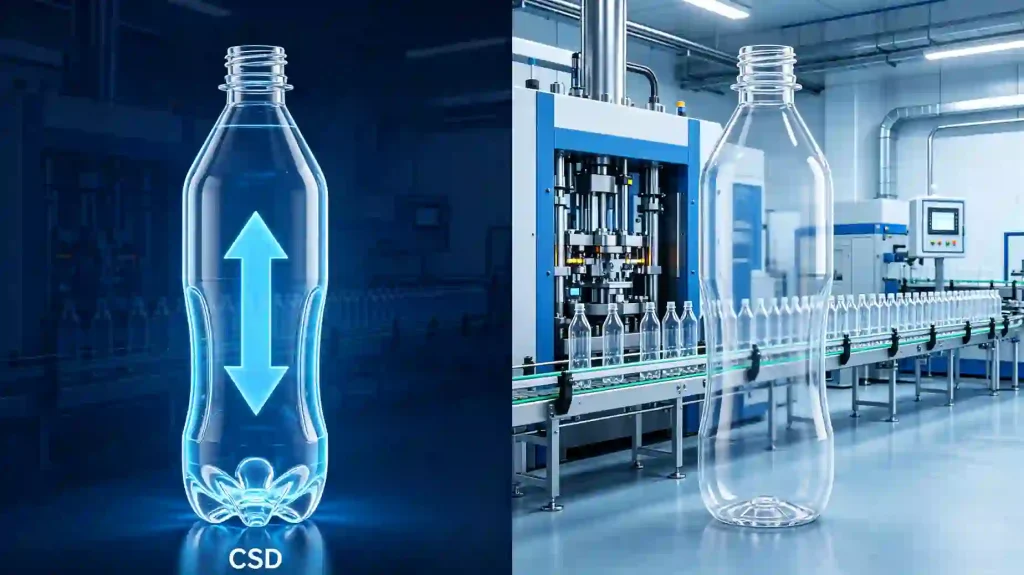
The Structural Engineering Difference Between CSD and Still Water Containers
A still water bottle operates at atmospheric pressure after filling and capping. Its structural requirements — top-load resistance for stacking, drop-test integrity, and label panel flatness — are set by distribution and retail display demands. A CSD bottle operates as a pressure vessel from the moment of carbonation to the moment the consumer opens it. The container must contain internal pressure without permanent deformation (creep), without loss of dissolved CO₂ (permeation), and without failure under thermal excursion (storage in a hot vehicle, for example).
| Design Parameter | Still Water Bottle | CSD Bottle |
|---|---|---|
| Internal pressure at fill (20°C) | ~0 bar (atmospheric) | 3.5–4.5 bar |
| Thermal abuse pressure (38°C, direct sun) | Not applicable | Up to 6.5 bar |
| Base geometry | Flat or slight dome — optimized for stability and material saving | Petaloid (5- or 6-foot) — distributes hoop stress at base radius |
| Recommended wall thickness (body) | 0.22–0.28mm (lightweight design) | 0.28–0.38mm (pressure-grade) |
| Hoop stress at 4.5 bar (500ml, 65mm body Ø) | Not relevant | ~7.3 MPa — within oriented PET strength envelope only if SRh ≥ 3.5× |
| CO₂ permeability requirement | Not applicable | CO₂ loss ≤ 15% over shelf life (typically 6–9 months) |
Engineering consequence: The hoop stress at 4.5 bar internal pressure in a 500ml CSD bottle (65mm body diameter, 0.30mm wall) reaches approximately 7.3 MPa. Biaxially oriented PET has a yield strength of 140–160 MPa in the hoop direction — well above this stress. But only if the hoop stretch ratio (SRh) is ≥ 3.5× and the conditioning temperature was correct during blowing. Under-conditioned PET (low SRh, insufficient orientation) has a hoop strength of 50–80 MPa — below the failure threshold at thermal abuse pressure. The blow molding machine’s conditioning accuracy is therefore a structural safety parameter for CSD bottles, not merely a quality parameter.
Blow Pressure Specification: Why CSD Bottles Need 35 kg/cm² vs 26 kg/cm² for Still Water
Main blow pressure serves two functions: it inflates the preform to the mold cavity dimensions, and it forces the oriented PET against the mold surface to replicate fine surface detail and achieve dimensional accuracy. For still water bottles, 26–30 kg/cm² is sufficient — the smooth wall geometry does not require high surface-forming pressure, and the lightweight wall thickness (0.22–0.28mm) does not resist inflation at lower pressure. For CSD bottles, the petaloid base geometry demands higher pressure.
| Pressure Zone | Still Water Bottle | CSD Bottle | Reason for Difference |
|---|---|---|---|
| Pre-blow pressure | 6–8 kg/cm² | 8–12 kg/cm² | CSD preform wall is thicker — needs higher pre-blow to initiate inflation against greater resistance |
| Main blow pressure | 26–30 kg/cm² | 32–35 kg/cm² | Petaloid foot geometry requires higher pressure to fully form the 5–6 foot radii and ensure no short-shot at foot tips |
| Blow-hold duration | 0.8–1.2s | 1.2–1.8s | Thicker CSD wall requires longer hold to cool below Tg before mold opening — prevents springback at petaloid feet |
Compressor implication: Upgrading a still water line to CSD production requires verifying that the high-pressure compressor can deliver 35 kg/cm² — not just 26–30 kg/cm². Most compressors specified for still water production are rated at 30 bar maximum working pressure. Running at 35 kg/cm² on a 30 bar compressor exceeds the pressure vessel rating. This is a safety and insurance issue, not merely a performance issue. Confirm compressor rated pressure before switching a still water machine to CSD production.
Petaloid Base Formation: The Machine Parameter That CSD Bottle Quality Depends On
The petaloid base — the multi-footed hemispherical structure that replaces the flat base of a still water bottle — is the most mechanically demanding zone of a CSD container. It must resist radial creep under sustained internal pressure (a phenomenon called base rollout or base peaking), survive the drop-test impact at the foot tips, and maintain stable standing geometry so the filled bottle does not rock on a flat surface.
Three machine parameters directly govern petaloid base quality:
| ||
| ||
|
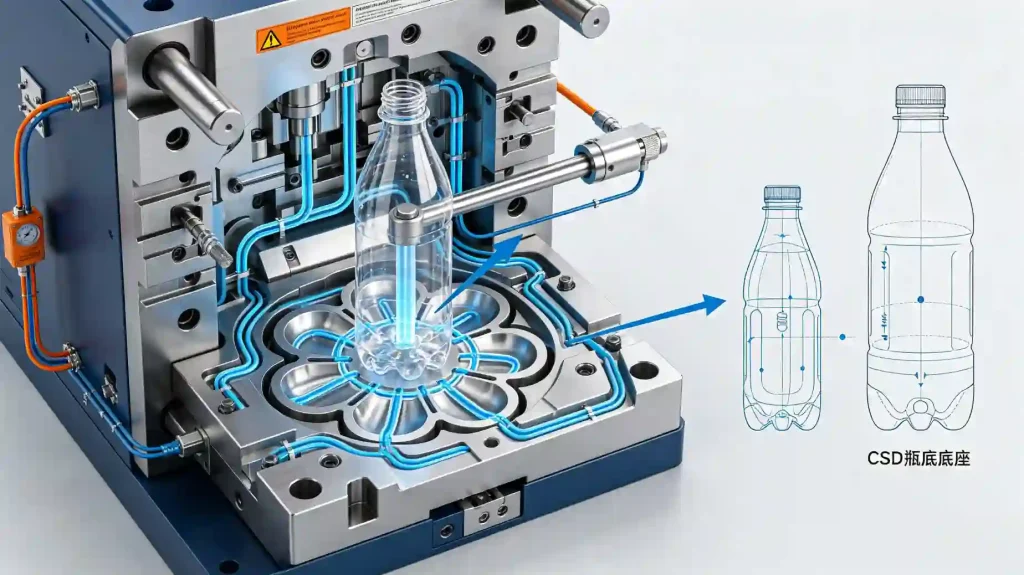
Molding and Quality Control of Five-Petal Flower Bases
CO₂ Permeation and Biaxial Orientation: The Machine’s Role in Shelf Life
Carbon dioxide molecules permeate through PET via a solution-diffusion mechanism — they dissolve into the PET matrix on the high-pressure (inside) face and diffuse through the wall to the low-pressure (outside) face. Biaxial orientation reduces CO₂ permeability by two mechanisms: it increases PET crystallinity (oriented chains pack more tightly, reducing free volume), and it creates a more tortuous diffusion path for CO₂ molecules through the oriented amorphous zones.
| Orientation Level | Planar Stretch Ratio | CO₂ Permeability (relative) | Shelf Life Impact |
|---|---|---|---|
| Under-oriented (defect) | < 5× | 1.8–2.4× baseline | CO₂ loss ≥ 25% at 6 months |
| Marginal orientation | 5–8× | 1.2–1.5× baseline | CO₂ loss 15–20% at 6 months |
| Target orientation (CSD grade) | 8–12× | 1.0× baseline | CO₂ loss ≤ 12% at 6 months ✓ |
| High orientation | > 12× | 0.7–0.85× baseline | CO₂ loss ≤ 8% at 9 months — marginal gain vs stress-cracking risk at SR > 14× |
The machine controls achieved orientation through conditioning temperature uniformity and blow pressure timing. On a JS-series machine with 10-zone independent IR conditioning, the body zone temperature uniformity of ±3°C around the circumference ensures that orientation is consistent across all points on the bottle surface — preventing zones of low local orientation that would become CO₂ permeation hotspots in the finished CSD bottle.
Häufig gestellte Fragen
▶ Can the same mold set be used for both CSD and still water bottle production by changing machine parameters?
▶ What is the base rollout test and how does it relate to machine settings?
▶ Can PET CSD bottles be produced alongside still water bottles on the same machine in the same shift?
▶ What wall thickness specification is required for a 500ml PET CSD bottle at 4.5 bar carbonation?
Switching between CSD and still water on the same line?
Share your bottle volumes, carbonation levels, and existing compressor rating — receive a machine configuration assessment and tooling changeover plan from the Ever-Power engineering team.