
A PP baby bottle that fails in the sterilizer is a product recall risk, a consumer complaint, and a material science problem that originates at the blow molding machine. The bottle’s ability to survive steam sterilization at 121°C, microwave sterilizer cycles at 850–1,000W, and repeated dishwasher cycles at up to 70°C is not determined solely by the PP resin specification — it is determined by the combination of resin properties, blow temperature during production, crystallinity level in the finished bottle, wall thickness uniformity, and residual orientation stress. A bottle produced from the correct PP grade but blown at the wrong conditioning temperature can fail a steam sterilization test that an identical bottle blown correctly would pass. This article establishes the machine parameters that govern PP baby bottle sterilization compatibility, the test protocols that buyers use to verify compliance, and the process controls that maintain sterilization resistance across production batches.
The three sterilization methods and what each demands of the PP bottle
Steam, microwave, and UV-C sterilization — temperature exposure, mechanical stress, and PP failure modes for each
Steam sterilization (electric steam sterilizer, 100–121°C). Electric steam sterilizers for baby bottles operate at either ambient pressure (100°C boiling at sea level, 5 minutes typical cycle) or at positive pressure (105–121°C autoclave-type, 3–5 minutes). Both temperatures are well below PP’s crystalline melt temperature of 145–152°C (random copolymer), but they approach or exceed the temperature at which PP’s amorphous zones — the fraction of the polymer that is not crystalline — begin to soften. The amorphous zone Tg for PP is approximately −10 to +5°C (well below ambient), which means the amorphous zones are already above Tg at room temperature and do not contribute to mechanical stiffness; stiffness in PP is entirely from the crystalline zones at use temperature. The question is whether the crystalline zones provide adequate restraint against deformation at 100–121°C. The answer depends on the crystallinity level of the finished bottle: PP random copolymer at ≥40% crystallinity maintains adequate stiffness to resist deformation under its own weight and the internal steam pressure during a typical electric steam sterilizer cycle. PP bottles at <35% crystallinity (under-cooled during blow molding or produced from a low-nucleating-agent resin grade) show measurable base deformation or body ovality increase after steam sterilizer cycles.
The machine parameter that directly controls finished bottle crystallinity is the blow-hold dwell time and mold cooling water temperature combination. During the blow-hold phase, the mold surface (at 8–12°C) rapidly cools the outer surface of the PP bottle wall, nucleating crystallization from the outside in. The cooling rate and the time available for crystallization before mold opening determine the final crystallinity level. If the blow-hold dwell is too short (the bottle is ejected before crystallization has progressed adequately through the wall thickness), the inner portion of the wall has lower crystallinity than the outer surface — and it is the inner surface that contacts the steam during sterilization and experiences the highest thermal load. A bottle with adequate outer surface crystallinity but low inner surface crystallinity may appear dimensionally stable at room temperature and fail in the sterilizer because the inner PP softens and yields under the steam temperature and internal pressure combination.
Microwave sterilizer (800–1,000W, 2–5 minutes with water inside). Microwave sterilizers for baby bottles use microwave energy to heat water placed inside the bottle to boiling (100°C at ambient pressure) — the steam generated inside the bottle sterilizes the internal surface. The PP bottle is not directly heated by microwave energy (PP is a non-polar polymer and absorbs microwave energy minimally), but it is heated by contact with the boiling water and the internal steam. The key failure mode for PP baby bottles in microwave sterilizers is not thermal deformation — at 100°C, a correctly crystallized PP bottle has adequate stiffness — but cyclic thermal stress cracking. Repeated microwave sterilization cycles (the PP bottle used by a typical parent is sterilized 3–5 times per day for the first 3–6 months of the baby’s life — potentially 450–900 sterilization cycles) introduce repeated thermal expansion and contraction cycling in the PP wall. In zones of high residual stress (gate area, sharp geometry transitions, any zone with uneven wall thickness), this cyclic stress initiates micro-cracking that progresses over 100–200 cycles to visible surface crazing or — in the worst case — through-wall cracking.
UV-C sterilization (253.7nm wavelength, 5–10 minutes). UV-C sterilizers do not heat the PP bottle — they use short-wavelength UV light to denature bacterial and viral surface contamination. For the PP bottle material, UV-C exposure is a photodegradation risk: PP absorbs UV radiation at wavelengths below 280nm (including 253.7nm) and the absorbed energy breaks C–H and C–C bonds in the polymer backbone, progressively reducing molecular weight and causing yellowing. The rate of photodegradation depends on the PP resin’s UV stabilizer additive package. Standard food-grade PP for baby bottles contains a UV stabilizer (typically HALS — hindered amine light stabilizer, such as Tinuvin 622 or Chimassorb 944) at 0.05–0.15% by weight, which provides adequate UV resistance for normal ambient UV exposure (sunlight through a window) but may be insufficient for intense daily UV-C sterilization at 253.7nm. For UV-C sterilizer compatible PP baby bottles, the resin must contain a UV stabilizer package specifically evaluated for UV-C lamp exposure — not just sunlight UV stability. The machine producer’s role in UV-C compatibility is to ensure that the processing temperatures used do not degrade the UV stabilizer during melt processing: HALS stabilizers begin to volatilize above 280°C, and barrel temperatures should not exceed 255°C for UV-stabilized PP grades.
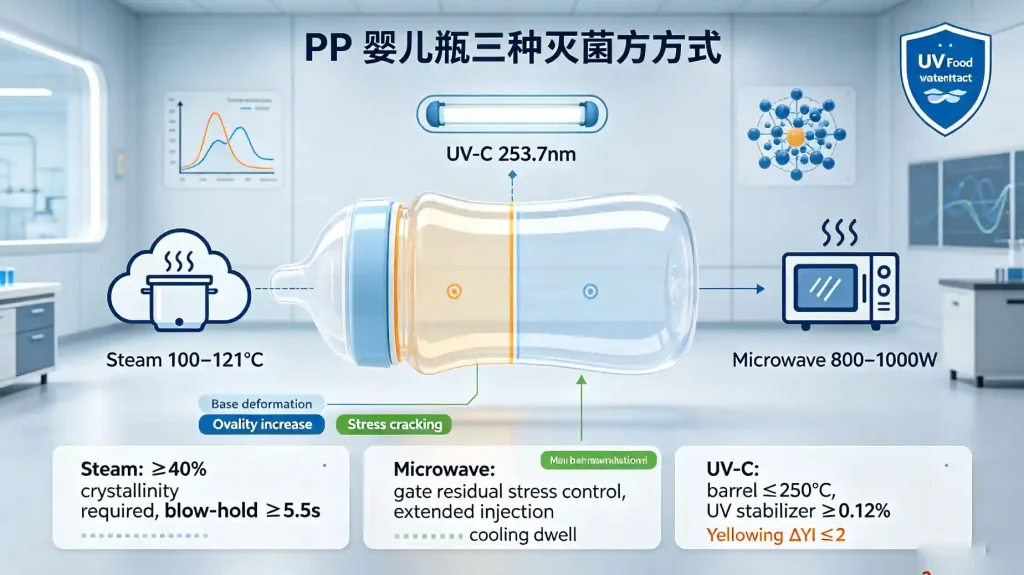
Machine-controlled parameters that govern sterilization resistance
How blow-hold dwell, mold temperature, and gate zone conditioning translate to crystallinity and residual stress
Crystallinity in the finished PP baby bottle is not directly measurable during production — it requires DSC (differential scanning calorimetry) analysis of a bottle wall sample, which is a laboratory test with a 30–60 minute turnaround. The production proxy for crystallinity is the blow-hold dwell time combined with the mold cooling water temperature. A calibrated dwell-temperature combination that consistently produces bottles passing the boiling water resistance test (100°C, 5 minutes, filled) is the practical proxy for adequate crystallinity — because passing this test requires a minimum crystallinity level to maintain stiffness under the test conditions. The dwell-temperature relationship for a 150ml PP random copolymer baby bottle (0.8mm body wall, 12°C mold cooling water) is as follows:
The productivity trade-off: sterilization resistance vs output rate
Extending blow-hold dwell from 2.5 seconds (sterilization failure) to 6.5 seconds (full steam sterilizer compatible) increases cycle time by 4 seconds per bottle — reducing output from approximately 1,440 bph to approximately 900 bph on a 4-cavity machine (a 37.5% output reduction). This trade-off is inherent to PP baby bottle production — buyers who compare PP baby bottle output rates with PET water bottle rates are comparing containers with fundamentally different processing requirements. The correct basis of comparison is the daily production volume: a 4-cavity PP baby bottle machine running at 900 bph for 16 hours produces 14,400 bottles per day, which is a commercially viable output for all but the highest-volume baby bottle producers.
Sterilization compatibility testing protocols and production QC verification
How buyers test sterilization resistance — and what the production QC program must maintain
There is no single international standard for baby bottle sterilization resistance testing — the market uses a combination of standards from different regulatory frameworks. The most referenced are: GB/T 33762 (China) which specifies the boiling water resistance test (≥95°C water, 5 minutes, filled, capped — no deformation or cracking); EN 14350-2 (EU) which covers chemical migration for baby articles but not sterilization resistance explicitly; ASTM F2012 (USA) for baby feeding bottles which references no specific sterilization test but requires compliance with FDA 21 CFR 177.1520. In practice, major retail buyers (Philips Avent, Tommee Tippee, Dr. Brown’s, Chicco as OEM suppliers) impose their own internal sterilization durability specifications that typically require: the bottle to pass 200 sterilizer cycles in the brand’s specified sterilization method (electric steam, microwave, or dishwasher at 65°C) without visible deformation, cracking, or opacity change beyond a defined ΔYI limit (typically ΔYI ≤2 over 200 cycles).
For production QC, the sterilization resistance cannot be tested on every bottle — the test is destructive and time-consuming. The production QC approach uses the boiling water resistance test as a process proxy: 2 bottles per production batch (or every 2 hours on a continuous line) are filled with 100°C water, capped, and held for 5 minutes. The pass criterion is no visible deformation. If both bottles pass, the production batch is released. If either bottle fails, the batch since the last passing check is quarantined and investigated. The blow-hold dwell setting that passes the 5-minute boiling water test at the specified mold cooling water temperature is then the validated production minimum dwell — this dwell becomes part of the PLC recipe and is interlocked with a machine alarm if the actual dwell falls below the minimum by more than 0.2 seconds for any cycle.
Frequently asked questions
Developing a PP baby bottle with sterilizer compatibility claims?
Share your target sterilization method, cycle count requirement, PP resin grade, and container geometry — receive machine parameter recommendations and a sterilization validation protocol guide.