
Pharmaceutical container material selection sits at the intersection of formulation chemistry, regulatory science, and manufacturing process capability. The decision is not reversible without a regulatory submission — changing the container material for an approved drug product in most major markets (US, EU, Japan) requires a post-approval change submission that can take 12–36 months to process, depending on the change category and the regulatory authority’s assessment of the risk. This means the material specification must be defensible before the first batch is manufactured for clinical trials, and it must remain correct through product lifecycle. Three materials dominate pharmaceutical container production for oral and topical dosage forms: standard bottle-grade PET (polyethylene terephthalate), PETG (PET modified with 1,4-cyclohexanedimethanol, CHDM), and HDPE (high-density polyethylene). Each has a distinct property profile, regulatory history, and extractables character that determines where it belongs in the container selection matrix.

Comparison of Properties of Pharmaceutical Container Materials
Material property comparison: the parameters that drive pharmaceutical container selection
Physical, chemical resistance, regulatory, and processing properties — with quantified values
The crystallinity difference between PET and PETG is the root cause of most of their processing and performance differences. Standard bottle-grade PET, when biaxially oriented during blow molding, develops crystallinity of 25–35% (measured by density or DSC). This crystalline structure is responsible for PET’s barrier properties, its stiffness, and its transparency — but also for its propensity to crystallize if held too long in the conditioning station above its crystallization temperature (approximately 140–175°C for PET at typical blow molding heating rates). PETG’s CHDM comonomer disrupts the crystalline packing geometry, reducing crystallinity to <5% even under biaxial orientation conditions. The practical result is that PETG cannot become opaque or haze-white from crystallization during processing — a common failure mode on PET when conditioning temperature is too high or dwell time too long — and PETG maintains its amorphous optical clarity through the blow cycle without the precision temperature control window that PET requires.
However, the same CHDM disruption that prevents crystallization also eliminates the orientation-hardening response that makes biaxially oriented PET stiff and dimensionally stable. PETG containers have substantially lower flexural modulus (approximately 2.0–2.3 GPa for PETG vs. 3.5–4.5 GPa for oriented PET) and lower top-load resistance per gram of material. For pharmaceutical oral liquid containers, this difference means that a PETG container meeting the same top-load specification as a PET equivalent must be produced with a heavier wall — typically 20–35% heavier — which increases material cost and container weight but enables the clinical clarity and dimensional precision (no orientation-induced residual stress) that PETG offers.
HDPE for pharmaceutical containers is primarily used in oral solid dosage (OSD) applications — tablet and capsule bottles — where its principal advantages are moisture barrier (MVTR approximately 0.5–1.5 g·mm/m²·day vs. 3–8 for PET), UV opacity (HDPE blocks >95% of UV at wavelengths 300–400nm without additive), excellent ESCR across a wide range of chemical environments including high-concentration surfactants and strong acids, and autoclave sterilizability (HDPE melting point 130°C survives 121°C steam cycles intact). HDPE’s disadvantages for pharmaceutical applications are its opacity (no content visibility), its lower dimensional precision (HDPE injection-molded or blow-molded containers have wider dimensional tolerances than ISBM PET or PETG containers because of the HDPE’s semi-crystalline shrinkage behavior), and its higher oxygen transmission rate (OTR approximately 400–600 cc·mm/m²·day·atm vs. 3–8 for PET) — which matters for moisture-sensitive solid dosage forms where the package headspace oxygen contributes to active pharmaceutical ingredient degradation.
Extractables and leachables: the regulatory science that drives material selection
USP <1663>, ICH Q3E, and the practical differences between PET, PETG, and HDPE extractables profiles
Extractables are compounds that can be extracted from a container material under exaggerated laboratory conditions (aggressive solvents, elevated temperatures). Leachables are the subset of extractables that actually migrate into the drug product under normal storage conditions. The ICH Q3E guideline (Guideline for Extractables and Leachables for Inhalation and Nasal Drug Products, 2021, with oral pharmaceutical guidance in development) and USP <1663> (Assessment of Extractables Associated with Pharmaceutical Packaging/Delivery Systems) define the framework for demonstrating that a container’s leachables profile does not pose an unacceptable risk to the patient.
For standard bottle-grade PET (IV 0.72–0.84 dL/g, manufactured from dimethyl terephthalate or terephthalic acid and ethylene glycol with no added colorants or processing aids beyond a standard antimony or titanium catalyst), the extractables profile is well-characterized and the regulatory data package for PET pharmaceutical containers is highly developed. The primary extractables from PET under aqueous and slightly acidic conditions are acetaldehyde (AA), diethylene glycol (DEG), and trace levels of terephthalic acid and ethylene glycol monomers. Antimony leachables are present at single-digit µg/l levels in water extracts and are covered by existing WHO, EU, and FDA limits. For oral pharmaceutical applications (not parenteral), a PET container’s aqueous extractables profile at standard simulation conditions (pH 7 buffer, 70°C, 24h) typically passes USP <661> Type III limits without any container-specific study, relying on the existing body of regulatory data for PET food-contact materials.
PETG’s extractables profile is materially different from standard PET. The CHDM comonomer introduces 1,4-cyclohexanedimethanol (CAS 105-08-8) as a potential leachable — a compound not present in standard PET extractables data. Under aqueous extraction conditions at 70°C, CHDM leachables from PETG containers are typically in the 10–50 µg/l range, which is above the analytical evaluation threshold (AET) for oral pharmaceutical products under ICH Q3E methodology and requires a toxicological assessment. Additionally, PETG’s amorphous structure exposes a larger effective surface area of amorphous polymer per unit wall thickness compared to semi-crystalline PET, which means the rate of oligomer extraction under simulated use conditions is higher for PETG. The practical regulatory consequence is that a packaging scientist who attempts to use existing PET extractables data to support a PETG container in a drug product dossier will receive a deficiency letter from EMA or FDA requesting PETG-specific extractables data. This is not a theoretical risk — it is a documented pattern in regulatory submissions for PETG pharmaceutical containers. The extractables study for a PETG container in a new drug application requires a purpose-designed protocol covering: aqueous extractants at multiple pH values (pH 4.5, 7.0, and if relevant for the formulation, pH 2.0); alcoholic extractants at 20% and 50% ethanol to capture alcohol-extractable species; and a toxicological assessment of any compound above the AET. Study duration: typically 16–24 weeks from sample receipt to final report.
HDPE extractables for pharmaceutical oral solid dosage applications are supported by the most extensive regulatory data of the three materials, because HDPE has been the dominant OSD container material for over 50 years. Ph. Eur. 3.1.4 and USP <661> Type II testing is well-established for HDPE, and for many standard HDPE grades without pigments or fillers, an abbreviated extractables study citing existing regulatory data is accepted by FDA and EMA. The primary concern with HDPE is antioxidant extractables — HDPE resins for pharmaceutical containers contain BHT (butylated hydroxytoluene) or Irganox-type phenolic antioxidants as thermal stabilizers, and these can leach into aqueous or alcoholic pharmaceutical formulations at levels that require assessment. For sensitive formulations (inhalers, sublingual tablets) or formulations with ethanol content above 15%, HDPE antioxidant leachables must be specifically characterized and included in the risk assessment.
Drug formulation to container material selection logic
Which formulation chemistry, sterilization method, and market requirement drives the material choice
Aqueous oral liquid formulations — syrups, oral solutions, suspensions — are the primary domain for PET and PETG pharmaceutical containers. For standard aqueous formulations without significant alcohol (≤5% v/v) or surfactant content (≤2% w/v), both PET and PETG pass extractables assessment without special measures. The decision between PET and PETG then turns on optical requirements and formulation compatibility: PETG offers marginally lower OTR and better clarity uniformity (no orientation-induced birefringence at the shoulder zone), while PET offers lower extractables data burden (existing regulatory data can be cited) and higher top-load stiffness per gram of material. For suspensions containing fine particles, container inner surface roughness becomes a factor: a smoother inner surface (PETG’s amorphous structure allows the inner surface to replicate the mold core finish more faithfully than oriented PET) reduces particle adhesion to the container wall and improves content uniformity on shaking — a relevant quality consideration for oral suspension pediatric formulations.
For alcohol-containing oral pharmaceutical formulations — linctuses, tinctures, elixirs — the alcohol concentration is the primary selection driver. Ethanol acts as an ESCR-active substance for both PET and PETG: it swells the amorphous zones of the polymer, reducing chain entanglement and increasing susceptibility to crazing and cracking under mechanical stress. The alcohol concentration thresholds below which PET and PETG can be used without specific ESCR qualification are approximately 30% v/v for PET (IV ≥ 0.76 dL/g) and 25% v/v for PETG — below these thresholds, the formulation’s alcohol does not generate sufficient osmotic swelling pressure to initiate crack propagation in a correctly processed container under distribution stress conditions. Above these thresholds, HDPE is the preferred container material for alcoholic pharmaceutical formulations. For formulations in the 10–30% v/v range, compatibility testing (60 days at 40°C with the actual formulation, followed by container inspection and drug assay) is required before finalizing the container specification.
Oral solid dosage (OSD) containers — tablets, capsules, powders for reconstitution — are overwhelmingly HDPE for volumes above 30ml. The clinical requirement for content visibility (which drives PET and PETG for oral liquids) is not relevant for OSD products where the tablets are not identified through the container wall, and the superior moisture barrier of HDPE (MVTR 0.5–1.5 vs. 3–8 for PET) directly protects moisture-sensitive actives (amorphous solids, hydrolysis-susceptible molecules) without the need for desiccant inserts in many formulations. For OSD products where content visibility is a clinical feature — unit-dose dispensing systems, anti-counterfeiting applications with visible tablet geometries — a transparent PET or PETG container is specified with the explicit understanding that a desiccant sachet or desiccant-lined cap is required to manage the higher moisture ingress rate.
Aqueous oral liquids (syrups, solutions, suspensions, ≤5% v/v alcohol) → PET or PETG
Both materials pass aqueous extractables assessment; choose PETG for superior clarity and lower OTR; choose PET to reduce extractables data burden by citing existing regulatory data. For suspensions, PETG’s smoother inner surface reduces particle adhesion. For liquids requiring gamma irradiation sterilization, PET is preferred — PETG yellowing at 25 kGy (ΔYI 2–5) may be unacceptable for clear containers.
Oral solid dosage (tablets, capsules, powders for reconstitution) → HDPE above 30ml
HDPE’s moisture barrier (MVTR 0.5–1.5 vs. 3–8 for PET), UV opacity, and established regulatory data make it the standard for OSD above 30ml. For OSD below 30ml or where content visibility is specified, PET or PETG with desiccant-lined cap or desiccant insert.
Disinfectants and antiseptics (>30% v/v ethanol, oxidizing agents) → HDPE
High-concentration ethanol formulations (hand sanitizer ≥70% v/v IPA; surgical spirit) and hydrogen peroxide formulations above 3% v/v exceed PET and PETG’s ESCR limits. HDPE is the standard container material for these formulations. For chlorhexidine gluconate solutions, PET and PETG pass compatibility testing for most commercial concentrations (0.5–4% w/v); confirm with specific compatibility testing at 40°C for 60 days before finalizing the specification.
Products requiring autoclave sterilization (121°C steam, 15 psi) → HDPE only among these three materials
PET Tg of 72–76°C and PETG Tg of 78–83°C are both well below 121°C autoclave temperature. Neither material survives 121°C steam sterilization without permanent deformation. HDPE (Tm 130°C) handles standard autoclave cycles intact. For transparent containers requiring terminal steam sterilization, polypropylene (PP) or glass are the alternatives — not PET or PETG.
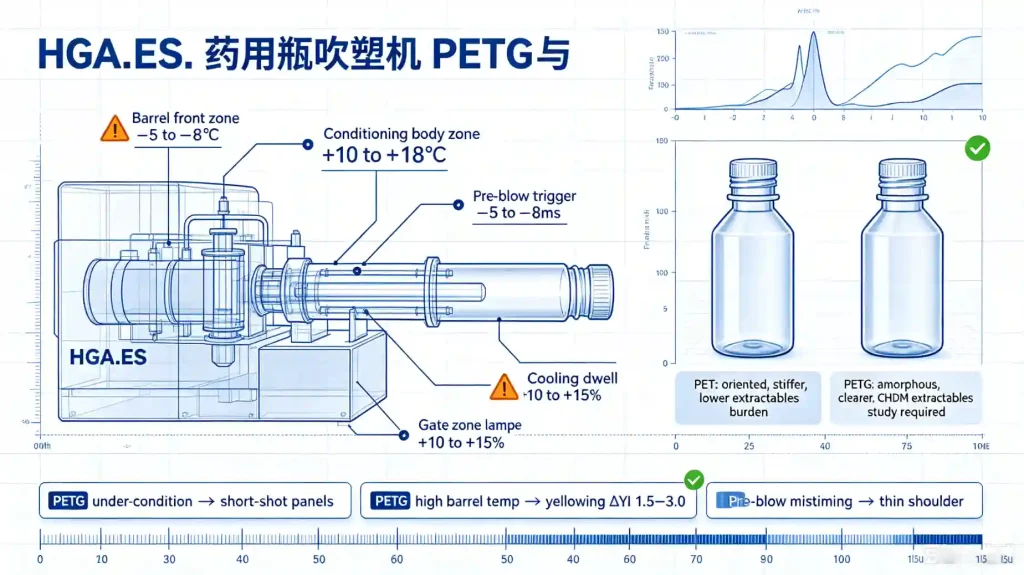
Differences in PET and PETG Blow Molding Process Parameters
HGA.ES machine processing: PET vs PETG parameter differences
The five machine parameter changes required when switching from PET to PETG — and the consequence if each is not made
Because PETG’s Tg is 6–7°C higher than standard bottle-grade PET (78–83°C for PETG vs. 72–76°C for PET, measured by DSC at 10°C/min heating rate), the blow window for PETG is correspondingly shifted upward by the same margin. This means the conditioning station IR lamp output must be set higher for PETG to reach the equivalent degree of softening — a body zone surface temperature of 115–130°C for PETG vs. 105–118°C for PET on the same preform geometry. If the PET recipe is applied to PETG without adjustment, the PETG preform arrives at the blow station 6–10°C below its effective blow temperature, producing short-shot panels on the opposing face and systematic base thinning. The first sign of this failure mode in production is a surge in scrap rate immediately after a material switch from PET to PETG without recipe adjustment — typically 15–30% scrap on the first 50–100 bottles before the operator identifies the cause.
PETG is also more sensitive to injection barrel temperature than PET. PETG begins to show measurable degradation (IV reduction, yellowing) at barrel front zone temperatures above 275°C, while standard PET tolerates 275–285°C without significant degradation at normal injection cycle times. On the HGA.ES series, the injection barrel front zone temperature for PETG production is set at 268–272°C — 5–8°C below the equivalent PET setting of 273–278°C. This difference is small enough that it could be overlooked in a rapid material changeover, but its consequence accumulates over a production shift: a front zone temperature of 278°C running PETG for 8 hours produces visible yellowing (ΔYI 1.5–3.0) in the finished container, detectable by the quality inspector and potentially reportable as an out-of-specification event against the container color specification.
Pre-blow timing requires advancing for PETG relative to PET. PETG at blow temperature is more compliant (lower instantaneous viscosity at the blow temperature for equivalent processing) than PET at the equivalent degree of softening above Tg. If the PET pre-blow timing (which triggers the low-pressure pre-inflation before the stretch rod reaches the preform base) is applied unchanged to PETG, the PETG preform over-inflates at the shoulder zone during the pre-blow phase before the stretch rod establishes axial tension — pulling too much material out of the shoulder and into the body, resulting in a thin shoulder with excess material at the body equator. The correction is to advance the pre-blow trigger by 5–8ms from the PET setting — reducing the interval between pre-blow initiation and stretch rod bottom contact, which reduces the degree of shoulder pre-inflation.
Named recipe library eliminates re-tuning time on material switches
The HGA.ES PLC stores product recipes by name — a PET recipe for a given container design is stored separately from the PETG recipe for the same design. Switching from PET to PETG production after a mold changeover requires recipe recall only (<60 seconds at the HMI); all five parameter adjustments described above are embedded in the PETG recipe and applied simultaneously on recall. The first-article inspection protocol (20 bottles, wall thickness at 5 axial positions, neck finish T and E measurement) still applies after any material switch — but the setup time from changeover to qualified production is limited by inspection time, not by parameter search time.
Frequently asked questions
Selecting container material for a new pharmaceutical product?
Share your drug formulation type, alcohol content, sterilization requirement, and target market — receive a material and machine specification recommendation with extractables study planning guidance.