
Baby bottle material selection is a decision made at the intersection of food safety regulation, thermal resistance engineering, and consumer market expectation. PET dominated the baby bottle market until bisphenol A (BPA) safety concerns, which were directed at polycarbonate (PC) bottles, caused a broader consumer shift toward BPA-free alternatives starting around 2010. PP (polypropylene) captured the largest share of the post-BPA baby bottle market because of its food-grade approval, sterilization resistance, and established safety record. Tritan (Eastman Chemical’s copolyester, trade designation Tritan TX2001 and related grades) emerged as the premium segment option — offering glass-like transparency without glass weight or breakage risk. Each material places distinct demands on the blow molding machine platform. Understanding why is the foundation for correct machine specification.
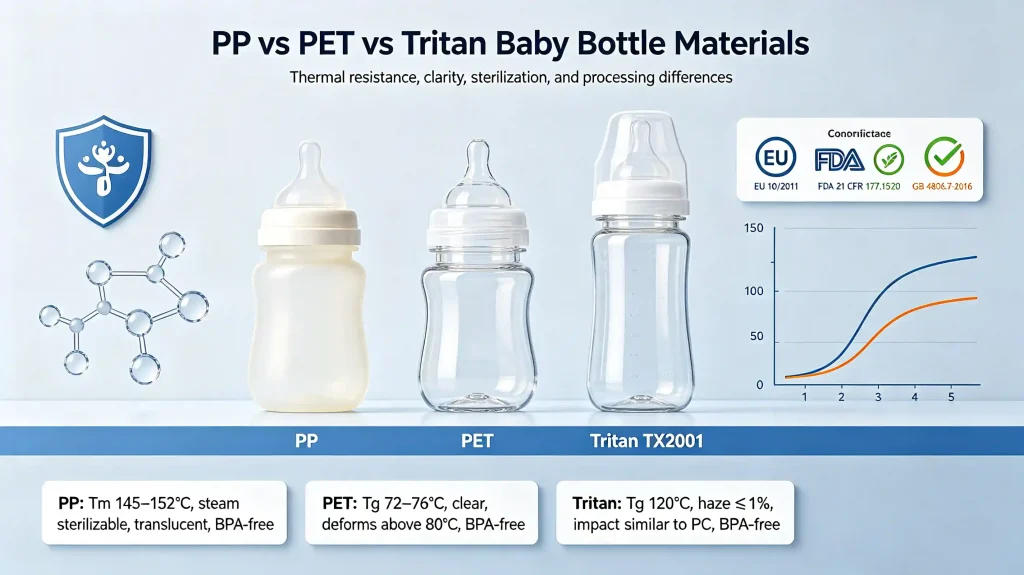
PP, PET, and Tritan: property comparison for baby bottle applications
Thermal resistance, clarity, chemical safety, and regulatory status — with quantified values
PP (polypropylene, typically food-grade homopolymer or random copolymer grades with MFR 8–25 g/10min at 230°C/2.16kg) is the dominant baby bottle material in volume terms. Its primary advantage is thermal resistance: the crystalline melt temperature of PP is 160–165°C (homopolymer) or 145–152°C (random copolymer used for baby bottles), which means PP bottles withstand steam sterilization at 121°C, electric steam sterilizer operation at 100°C, and boiling water at 100°C without deformation. This thermal stability is the requirement that eliminated PET from the baby bottle market — standard bottle-grade PET with a Tg of 72–76°C cannot survive steam sterilization. A PET baby bottle held in boiling water for 5 minutes deforms permanently; a correctly processed PP baby bottle survives hundreds of such cycles.
PP’s optical limitation is well-known: the semi-crystalline structure of PP (crystallinity 40–55% in typical food-grade grades) produces light scattering at the crystalline-amorphous interface that results in translucency rather than transparency. A PP baby bottle in natural color is milky-white and translucent — the caregiver can see the milk level approximately but cannot distinguish foam from liquid clearly through the wall. This translucency is acceptable for most caregivers — it is a familiar and trusted visual property of PP baby bottles — but it is a competitive disadvantage against Tritan in the premium retail segment. PP can be tinted with food-grade colorants to produce pastel or opaque colors that are used extensively in the mass market baby bottle segment, and color coding by volume graduation mark is a standard design feature.
Tritan (PCTG copolyester based on dimethyl terephthalate, 1,4-cyclohexanedimethanol, and 2,2,4,4-tetramethyl-1,3-cyclobutanediol, CBDO) achieves transparency equivalent to polycarbonate (haze ≤1% at 3mm thickness, measured per ASTM D1003) with confirmed BPA-free chemistry and thermal resistance sufficient to survive microwave sterilization at moderate power settings and dishwasher cycles at ≤70°C. Tritan’s primary processing challenge is its higher processing temperature than standard PET — injection barrel front zone temperatures of 280–295°C are typical for Tritan TX2001, compared to 268–278°C for PET and 220–235°C for PP. Tritan also has a melt viscosity that is sensitive to moisture — inadequate drying (target ≤50 ppm, recommended drying at 90–100°C for 4–6 hours in a desiccant dryer) produces surface streaks and haze in the blown bottle that are immediately visible and result in 100% rejection.

Why PP baby bottle blow molding requires a dedicated machine platform
Conditioning architecture, stretch ratio limits, and blow pressure regime — the three machine differences
PP cannot be stretch blow molded using the same conditioning architecture as PET. The fundamental difference is that PP has no equivalent to PET’s strain-hardening response — the crystallization-induced stiffening that stops PET from thinning beyond a target wall thickness during biaxial stretching. In PET blow molding, strain-induced crystallization begins when the local stretch ratio exceeds approximately 3× in the hoop direction, increasing the local modulus and distributing subsequent stretch to adjacent thicker zones. This auto-balancing mechanism is what makes PET blow molding produce consistent wall thickness across complex bottle geometries. PP does not crystallize under strain at the temperatures used in blow molding — it remains viscous throughout the blow cycle and thins proportionally to the applied stress without the self-limiting mechanism. The consequence is that PP requires a much narrower conditioning temperature window (typically ±3°C around the optimal blow temperature for PP vs ±8°C for PET on the same preform geometry) to avoid either insufficient inflation (too cold) or uncontrolled thinning at stress concentrations (too hot).
The stretch ratio for PP baby bottles is also fundamentally different from PET bottle production. PET beverage bottles achieve planar stretch ratios of 8–14× (axial SR × hoop SR) because strain hardening distributes the stretch evenly. PP baby bottles are limited to planar stretch ratios of 3–6× — above this range, the PP wall thins non-uniformly and produces a defect known as tiger-striping or stress whitening, where zones of different orientation level produce visible alternating bands in the bottle wall. For a standard 150ml PP baby bottle with a 60mm body diameter and 120mm height: the axial stretch ratio is approximately 1.5–2.0× and the hoop stretch ratio is approximately 2.5–3.5×, for a planar stretch ratio of approximately 3.75–7.0×. Staying within this envelope requires a preform designed with a proportionally shorter body (less axial travel for the stretch rod) and a thicker wall (more material to distribute over the smaller stretch ratio) than a PET preform for a comparable volume.
Blow pressure for PP is lower than for PET: typically 18–22 kg/cm² for PP baby bottle body geometry vs 26–35 kg/cm² for PET bottles of comparable volume. The lower pressure is appropriate because PP at blow temperature is more compliant than PET — it inflates fully at lower pressure — and higher pressures can cause the PP to stretch beyond the mold cavity geometry and create flash at the mold parting line. The blow-hold dwell for PP is longer than for PET because PP’s thermal conductivity is lower (approximately 0.12 W/m·K for PP vs 0.15–0.24 W/m·K for oriented PET), which means more time is required to cool the PP wall through its crystallization temperature range before the mold opens. For a 150ml PP baby bottle with a 1.5mm body wall, the blow-hold dwell is typically 4–7 seconds at a mold cooling water temperature of 8–12°C — compared to 1.5–3 seconds for a PET bottle of equivalent geometry.
The HGA PP baby bottle machine series addresses these requirements through a dedicated conditioning station with narrower temperature band control (±2°C vs ±5°C on standard PET machines) and a displacement blow architecture that applies the stretch rod in a velocity-controlled rather than pressure-controlled mode — which is critical for PP because velocity-controlled stretch maintains the axial stretch ratio independent of the preform’s instantaneous viscosity (which varies more strongly with temperature for PP than for PET). The machine’s screw and barrel geometry is also material-specific: PP requires a higher compression ratio screw (3.0–3.5:1 vs 2.5–3.0:1 for PET) because PP’s lower melt strength requires more controlled compression to develop uniform melt pressure without surging — a defect where the injection pressure oscillates cycle-to-cycle and produces bottles with variable preform weight and therefore variable wall thickness.
Special-shaped PP bottle production: the geometry challenge
Asymmetric body forms, anti-colic channel geometry, and the process controls that make them achievable
Standard round baby bottles are the starting point; the market increasingly demands special-shaped PP bottles — angled necks, anti-colic vent channel integrated into the bottle body, ergonomically contoured grip zones, wide-neck formats for spoon feeding, and oval cross-section bottles for one-hand grip. Each geometric departure from a cylindrical body introduces a local stretch ratio variation around the circumference — exactly the condition that, without appropriate machine control, produces tiger-striping and wall thinning at the geometry transition zones.
An angled-neck PP baby bottle (where the neck is offset from the body axis by 15–30°) is a good example of the challenge. During the stretch blow cycle, the stretch rod must travel along the bottle’s geometric centerline — but if the neck is angled, the stretch rod cannot be aligned with both the preform body axis and the final container centerline simultaneously. The standard approach is to design the preform with the body axis aligned to the blow station stretch rod, and to use the mold geometry to redirect the neck geometry during the blow phase — which requires the PP at the neck-to-shoulder transition to stretch asymmetrically: more stretch on the inner radius of the angle and less on the outer radius. Without precise conditioning temperature control at the neck-to-shoulder zone (typically a 6–8% reduction in lamp output at this zone relative to the body zone for PP), the inner radius over-stretches and the outer radius under-stretches, producing an angled bottle with visible wall thickness bands visible against backlighting.
Anti-colic bottles present a different challenge. The anti-colic vent system in modern baby bottles (Philips Avent Natural, Dr. Brown’s, Mam, and similar) typically involves an internal vent tube, a vented teat collar, or — in the ISBM version — an integrated vent channel molded into the bottle body wall. For ISBM PP production of an anti-colic channel geometry, the channel is formed by a mold insert projecting into the cavity space — which means the PP must blow around the insert without bridging (incomplete inflation) at the channel edges. The blow pressure and dwell sequence for anti-colic channel production is a multi-step protocol: pre-blow at 8–10 kg/cm² to initiate inflation and seat the preform against the channel insert edges, followed by main blow at 20–22 kg/cm² to fully replicate the channel geometry, followed by a pressure-hold at 15–18 kg/cm² during the cooling dwell to prevent channel spring-back as the PP crystallizes against the insert. A machine without the three-stage blow pressure control required for this protocol — with pre-blow, main blow, and hold phases independently settable — cannot produce a dimensionally consistent anti-colic channel in PP.
Food safety and regulatory compliance for PP baby bottle production
EU Regulation 10/2011, FDA 21 CFR 177.1520, Chinese GB standards, and production documentation requirements
PP baby bottle production for export to the EU market requires compliance with EU Regulation No. 10/2011 on plastic materials and articles intended to contact food, and specifically Commission Directive 93/11/EEC for N-nitrosamines and N-nitrosatable substances from rubber teats — relevant for the teat component, which is typically silicone or natural rubber, not the PP bottle body itself. For the PP bottle body, the key EU requirement is that the PP resin grade used is listed in the positive substance list of Annex I to EU Regulation 10/2011 (substance reference number 730, polypropylene, CAS 9003-07-0), that any additives used (antioxidants, nucleating agents, colorants) are also on the positive substance list, and that a Declaration of Compliance is issued by the manufacturer confirming the specific migration limits (SML) have not been exceeded. The EU SML for oligomers and additive-derived migrants from PP is covered by the overall migration limit (OML) of 60 mg/kg of food (or 10 mg/dm² of surface area) applicable to all plastic food contact materials under EU 10/2011.
For the US market, FDA 21 CFR 177.1520 (Olefin polymers) covers food-grade PP. The regulation specifies extractive limits (not more than 6.4 mg per square inch of surface area immersed in n-hexane at 50°C for 2 hours, and not more than 11.5 mg per square inch when tested with selected food-simulating solvents) and restricts the additive types permitted in food-contact PP to those covered by FDA’s threshold of regulation or by specific CFR sections covering individual additives. Antioxidants used in PP baby bottle resin must each be covered by either an FDA food additive regulation or a GRAS (generally recognized as safe) determination.
For the Chinese market — which is the largest single baby bottle market globally by volume — the primary standard for PP baby bottle food contact safety is GB 4806.7-2016 (National Food Safety Standard for Plastic Materials and Articles for Food Contact). GB 4806.7 specifies an overall migration limit of 60 mg/kg of food simulant (equivalent to EU 10/2011) and requires that all substances used in the plastic material are on the approved substance list (GB 9685-2016 covers additives; GB 4806.6 covers resins). The production documentation requirement for Chinese market baby bottles also includes compliance with the mandatory product standard GB/T 33762 for infant feeding bottles, which specifies the bottle’s volume accuracy (±5% of the marked capacity), graduation mark legibility, top-load resistance, and boiling water resistance test (fill with boiling water at ≥95°C for 5 minutes with cap closed — no deformation or cracking acceptable for PP).
Frequently asked questions
Specifying a PP or Tritan baby bottle blow molding line?
Share your target material (PP, Tritan, or both), bottle geometry, volume range, target market, and output requirement — receive a machine model recommendation and preform design guidance.