
The semi-automatic PET blow molding machine’s principal commercial advantage over an automatic machine is not throughput — it is format flexibility. A contract bottler running 20 different SKUs in monthly batches of 3,000–15,000 bottles each would require an automatic machine to go through 20 mold changeovers per month, each taking 60–150 minutes — a total of 20–50 hours of production downtime per month attributable to changeover. The same operation on a semi-automatic machine executes the same 20 changeovers in 20–45 minutes each — 7–15 hours total. For a business model built on format diversity at moderate volumes, this changeover speed advantage changes the economics of the operation entirely. This article addresses the mold management system, preform specification logic for multi-format production, and the operational protocols that allow a semi-automatic machine to switch between formats reliably and with minimal waste.
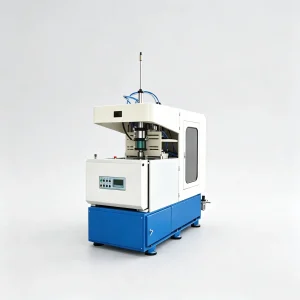
Mold management for multi-format semi-automatic production
Mold design standards, changeover procedure, and recipe management for a high-SKU-count operation
Effective mold management for a semi-automatic machine with a diverse format portfolio starts with standardization of the mold base. If every mold in the portfolio uses the same external mounting dimensions (the distance between the two mold half mounting faces, the locating ring diameter, and the cooling water port positions), the changeover procedure is the same for every format: unscrew the four mold clamping bolts, disconnect two cooling water connections, lift the mold halves out, insert the new mold halves, reconnect cooling water, tighten the clamping bolts, and verify the mold is seated flat against the clamping faces. This standardized procedure takes approximately 15–25 minutes with one operator. If mold bases are not standardized — if each mold has unique mounting geometry or cooling port positions — each changeover requires a different procedure and takes 30–60 minutes, with higher risk of cooling connection errors.
The HGA semi-automatic machine uses a standardized mold clamping system with universal mounting dimensions across all models in the semi-automatic range. This means mold tooling ordered for any HGA semi-automatic machine in the range is mechanically interchangeable with any other machine in the same range — an important operational advantage when a production floor has two or three semi-automatic machines and needs to balance production across them. The standard cooling water connection uses quick-disconnect push-fit couplings (DN8 or DN10 size, pressure-rated to 10 bar) rather than threaded fittings, which further reduces changeover time and eliminates the risk of cross-threading cooling connections during a time-pressured changeover.
The mold storage and maintenance protocol for a semi-automatic multi-format operation requires systematic attention that fully automatic operations sometimes neglect because their lower changeover frequency means molds sit in storage for longer periods between use. For a semi-automatic operation with 20 active mold sets: (1) each mold set is stored with the two halves closed around a polystyrene foam insert that maintains the mold in the closed position and prevents the parting faces from contact damage during storage; (2) the cooling water channels are blown out with low-pressure air and plugged with standard snap-in plastic plugs before storage — residual water in cooling channels causes corrosion at the channel walls and at the push-fit coupling inserts, which eventually blocks flow and causes asymmetric mold cooling; (3) the mold cavity surfaces are wiped with a light oil (such as WD-40 or a silicone mold release spray) and wrapped in acid-free tissue before storage — the cavity surface polish is the bottle’s exterior surface finish quality, and any corrosion or scratch introduced during storage is reproduced on every bottle produced with that mold.
PLC recipe management is the second pillar of effective multi-format operation. Each bottle format (defined by its preform specification and mold geometry) has a specific recipe in the HGA PLC that defines: heater zone outputs for each of the 6–8 IR zones (in % of rated lamp power); heater dwell time (seconds in the oven); blow pressure (pre-blow pressure in kg/cm², main blow pressure in kg/cm², blow-hold duration in seconds); stretch rod travel distance and speed; mold cooling water flow confirmation (minimum flow rate required before cycle initiation interlock allows blow to proceed). The recipe is named with the bottle format identifier (e.g., “500ml_PET_still_water_28g_preform”) and the date it was last validated. Recalling a recipe after mold change takes less than 30 seconds at the HMI touch screen, and the machine reaches thermal steady state within 10–15 minutes of recipe recall — meaning total non-production time after mold change is approximately 30–45 minutes before the first good bottle is produced.
Preform specification strategy for multi-format semi-automatic production
How to minimize preform SKU count while covering a diverse bottle format portfolio
The preform specification is the most significant inventory and cost management challenge for a multi-format semi-automatic operation. Each preform is defined by three geometric parameters that together determine which bottle formats it can produce: neck finish (T, E, H dimensions and thread type — PCO 1810, PCO 1881, 28mm, 38mm, etc.); body length (determines the maximum axial stretch ratio and thus the range of bottle heights achievable from that preform); and body wall thickness and weight (determines the volume range achievable and the bottle wall thickness). A preform with a 28mm PCO 1881 neck, 85mm body length, and 28g weight can produce bottles ranging from approximately 400ml (low axial stretch, heavy wall) to 700ml (high axial stretch, thinner wall) using the same preform with different molds. This range — approximately 1.5–2× the preform’s nominal design volume in either direction — is the flexibility window within which a single preform specification can cover multiple molds.
For a contract bottler operating 20 different bottle formats, a poorly designed preform portfolio might require 20 different preform specifications — creating 20 inventory lines, 20 minimum order quantities, and 20 reorder triggers. A well-designed preform portfolio groups bottle formats by neck finish type and volume range, and identifies the maximum number of formats that can be served by each preform specification within its flexibility window. A typical rationalized preform portfolio for a 20-format semi-automatic operation might use 4–6 preform specifications: one for small-volume formats (100–300ml, 15–18g, 28mm neck), one for mid-volume formats (300–700ml, 22–30g, 28mm or PCO 1881 neck), one for large-volume formats (700ml–2L, 35–52g, 28mm or 38mm neck), one for wide-neck formats (all volumes, 38–50mm neck), one for large-format containers (2L–10L, 80–180g, 38mm or custom neck), and one for pharmaceutical/cosmetic formats (100–500ml, 18–28g, 28mm or 20mm specialty neck).
The machine parameter consequence of running a single preform across multiple molds is that the heater recipe must be adjusted for each mold — even if the preform is identical. A 28g preform blown to a 500ml bottle has a body stretch ratio of approximately 7× (planar); the same preform blown to a 700ml bottle has a body stretch ratio of approximately 10×. At the higher stretch ratio, the preform body needs to be conditioned to a slightly higher temperature (2–4°C higher in the body zone) to flow to the larger mold cavity without short-shooting at the lower body and shoulder zones. The HGA PLC stores a separate recipe for each mold even when the preform is the same — so the operator does not need to manually calculate the temperature adjustment; the correct heater parameters are recalled automatically with the mold’s recipe.
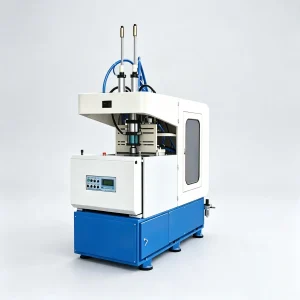
In-process quality control on a semi-automatic machine: operator-integrated QC
Using the operator’s position in the production cycle as an embedded quality checkpoint
The operator’s presence at every production cycle on a semi-automatic machine is a quality system advantage that is not available on an automatic machine without additional vision system investment. The operator handles every bottle at ejection and can perform a visual inspection at the rate of production. The practical QC procedure for a trained semi-automatic operator integrates three checks into the normal handling cycle without adding dedicated inspection time: (1) hold the ejected bottle at arm’s length and rotate it 360° under the available light — check for visible wall thickness banding (haze bands indicating non-uniform orientation), base clarity (confirming gate zone orientation and no gate shadow), and body surface defects (scratches from mold surface, short-shot zones visible as frosting); (2) squeeze the bottle body — a correctly conditioned and blown PET bottle has a firm, resilient feel; an under-blown bottle (insufficient blow pressure or too-cold preform) feels softer with less top-load resistance; (3) check the neck finish top surface and thread visually for flash, warp, or obvious dimension deviation. This three-check sequence takes approximately 2–4 seconds per bottle and identifies the majority of production defects before the bottle leaves the operator’s hands.
For format-specific quality requirements (pharmaceutical bottles requiring neck finish measurement, CRC-compatible bottles requiring T-dimension check, food bottles requiring top-load verification), a dedicated inspection step at the end of each set of 20–50 bottles is added to the operator protocol. The operator stops production, takes 2–3 bottles from the completed batch, and performs the format-specific measurement before resuming. This scheduled inspection approach is equivalent in principle to the SPC sampling on an automatic pharmaceutical line — it catches systematic drift (gradual change in wall thickness or neck finish due to mold cooling temperature change over the shift) before the drift produces out-of-specification bottles.
After every mold changeover, the operator produces 10 bottles and inspects all 10 against the format-specific QC checklist before releasing to production. Visual checks on all 10; dimensional checks (weight, neck T-dimension, height) on 3 of the 10. This 10-bottle first-article takes approximately 10 minutes — combined with the mold change time, total changeover-to-production time is 30–55 minutes.
Three-point check at ejection: 360° visual rotation, squeeze test, neck surface visual. Takes 2–4 seconds per bottle — fully integrated into transfer and loading cycle without stopping production. Any rejected bottle is set aside; if 3 consecutive rejections occur, stop production and investigate parameter drift before resuming.
Stop production after every 50 bottles; measure 2 bottles for weight and (if format-specific) neck finish T-dimension and height. If weight has drifted by >3% from the recipe target, adjust heater output accordingly. Record results on paper or PLC-integrated data entry before resuming. This check catches thermal drift as the ambient temperature changes over the shift.
At end of each production batch, measure 5 bottles for the full QC matrix. If any parameter has drifted from the recipe target (common for ambient-temperature-sensitive parameters like heater output when room temperature changes between seasons), update the recipe with the corrected value and save with a version date tag. The updated recipe is used as the starting point for the next production run of this format.
Operator training and productivity standards for semi-automatic production
Training program, productivity benchmarks, and fatigue management for sustained semi-automatic production
The semi-automatic machine operator is a critical process variable — more so than the operator of a fully automatic machine who primarily monitors rather than participates in the production cycle. An untrained operator produces more scrap (due to inconsistent transfer times), lower throughput (due to hesitation at the blow station), and more missed defects (due to unfamiliarity with what good-quality bottles look like). Training a semi-automatic operator to production-ready standard requires approximately 3–5 days of hands-on time: 1 day on machine operation and parameter adjustment; 1 day on defect recognition and quality inspection; 1 day on mold changeover procedure; and 1–2 days of supervised production with decreasing intervention until the operator meets the throughput and quality standards.
Productivity standards for a trained semi-automatic operator: transfer time from heater exit to blow station should be consistently within ±0.5 seconds of the calibrated average; cycle rate (bottles per hour) should be within 10% of the theoretical maximum for the recipe settings; and the in-cycle visual rejection rate should be below 3% under stable production conditions (this means the operator is correctly identifying and removing defects, not that 3% of all bottles are defective — a well-calibrated machine produces <1.5% true defects, and the remaining 1.5% of the 3% rejection rate is over-rejection due to operator conservatism, which is acceptable).
Operator fatigue over a production shift significantly affects output rate and inspection reliability on a semi-automatic machine — more than on an automatic machine. At the 6-hour mark of a continuous 8-hour production shift, operator transfer time typically increases by 15–25% from the beginning-of-shift average, reducing output rate by a corresponding amount. Two management approaches mitigate this: a structured rotation schedule (rotating the semi-automatic operator with a packaging or labeling role every 2 hours prevents the fatigue accumulation that occurs in a static 8-hour blow station assignment); or a production schedule that places the semi-automatic machine on two 4-hour shifts with a 30-minute break between shifts. Either approach maintains consistent output rate and inspection reliability across the production day.
Frequently asked questions
Running a multi-format PET bottle operation?
Share your format count, batch size per SKU, neck finish standard, and volume range — receive a mold portfolio rationalization plan and semi-automatic machine configuration recommendation.