
Recycled PET (rPET) is no longer a premium niche material — it is a procurement requirement for beverage producers selling into the EU market under the EU Single-Use Plastics Directive mandatory rPET content targets (25% from 2025, 30% from 2030 for beverage bottles) and a growing expectation across North American and Australian retail channels. The process challenge is real: rPET is not a drop-in replacement for virgin PET, and a blow molding machine set up for virgin PET will produce elevated scrap rates, increased wall thickness variation, and inconsistent optical clarity when it runs rPET without parameter adjustment.
Why rPET Behaves Differently: IV Degradation, Contamination, and Batch Variance
The processing differences between virgin PET and rPET originate in three fundamental material differences: intrinsic viscosity (IV) distribution, contamination level, and batch-to-batch property variance. Each creates a distinct processing challenge on the blow molding machine.
| Material Property | Virgin PET (bottle-grade) | rPET (food-grade, EU 282/2008) | Processing Consequence |
|---|---|---|---|
| IV (intrinsic viscosity) | 0.72–0.84 dL/g (tight range) | 0.68–0.82 dL/g (wide range) | Wide IV distribution → variable melt viscosity → conditioning temperature window shifts between batches |
| AA (acetaldehyde) content | 1–3 µg/g (virgin resin) | 4–12 µg/g (post-consumer) | Higher initial AA requires lower processing temperature to avoid EU 10/2011 AA migration exceedance |
| Color (yellowness index, YI) | YI < 2 (water-clear) | YI 3–15 (batch-dependent) | Higher YI requires either blending with virgin or accepting reduced bottle clarity — a brand decision, not a machine decision |
| Moisture content (pre-drying) | 50–80 ppm after drying | Often 150–300 ppm before drying; requires extended drying | Inadequate drying produces hydrolytic degradation during injection → further IV loss → unacceptable melt viscosity |
IV Variance and Conditioning Zone Adjustment: The Core rPET Processing Challenge
The blow molding machine’s conditioning station must bring the preform to the correct blow temperature — a temperature window where PET is compliant enough to stretch but has sufficient strain-hardening response to distribute material uniformly across the container surface. For virgin PET at IV 0.76 dL/g, this window is approximately 95–115°C surface temperature. For rPET at IV 0.72 dL/g, the window shifts to 90–108°C — because lower-IV material is more compliant at the same temperature and requires less heat to enter the blow window. For rPET at IV 0.80 dL/g (high end of rPET range), the window shifts to 98–118°C.
Conditioning Temperature Window by IV Level (500ml water bottle, standard preform geometry)
| IV (dL/g) | Blow Window — Body Zone (°C) | IR Lamp Output Adjustment vs Virgin | Risk if Not Adjusted |
|---|---|---|---|
| 0.72 | 90–108 °C | −8 to −12% body zone | Over-conditioning → excessive neck sag, base thinning, panel zone micro-crazing |
| 0.76 (virgin baseline) | 95–115 °C | Baseline (0%) | — |
| 0.80 | 98–118 °C | +5 to +8% body zone | Under-conditioning → short-shot panels, high scrap rate, wall thickness bias to body center |
| 0.68 (low-quality rPET) | 85–102 °C | −15 to −20% body zone | High AA generation risk; insufficient strain-hardening for uniform wall → high scrap; not recommended for UN-certified containers |
HGA JS-series control capability: The 10 independently controlled IR lamp zones allow precise zone-by-zone output adjustment for each rPET batch. When an incoming batch shows IV 0.72 vs the previous batch at IV 0.78, the body zone lamp output is reduced by 8–10% before the production run starts — achievable in under 5 minutes at the HMI without physical tooling changes. Batch-level recipe storage means rPET recipes are saved per supplier batch code and recalled instantly on repeat orders.
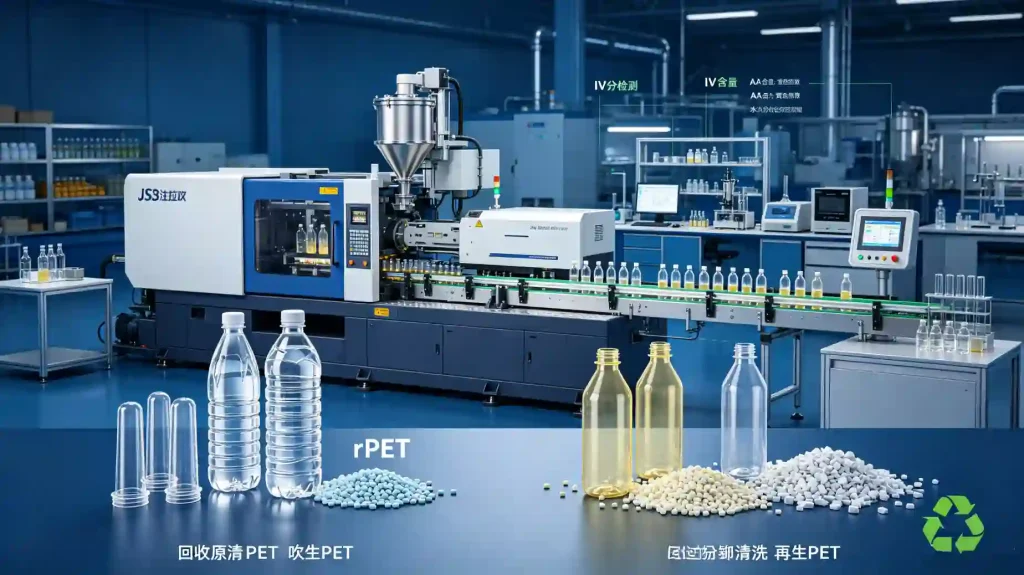
rPET Infrared Temperature Control Zones and Batch Recipe Management
Scrap Rate Control When Running rPET: The Five Adjustment Sequence
Transitioning a blow molding line from virgin PET to rPET without a structured adjustment sequence typically produces a 3–8% scrap rate in the first production hour before the operator locates the correct settings empirically. The following sequence minimizes startup scrap by targeting the highest-impact parameters in order of effect:
| ||
| ||
| ||
| ||
|
Virgin/rPET Blending Ratios: Output, Clarity, and Scrap Rate Trade-Offs
Most beverage producers do not run 100% rPET — they blend rPET with virgin PET at ratios that meet regulatory minimums while managing the process and quality trade-offs. The EU SUP Directive 25% minimum rPET target is the floor; many brands target 30–50% to build commercial differentiation. The table below shows the processing and quality outcomes at common blend ratios for a standard 500ml water bottle:
| rPET Content | Steady-State Scrap Rate | Optical Clarity (YI) | AA Migration Risk | Machine Adjustment Needed |
|---|---|---|---|---|
| 0% (virgin) | 0.8–1.2% | YI < 2 | Low | None — baseline recipe |
| 25% rPET | 1.0–1.5% | YI 2–5 | Low–medium | Body zone −3 to −5% lamp output; minor barrel temp reduction 2–3°C |
| 50% rPET | 1.5–2.5% | YI 4–8 | Medium | Body zone −6 to −10%; barrel temp reduction 3–5°C; AA scavenger resin recommended |
| 100% rPET | 2.5–4.5% | YI 6–15 | Medium–high | Full rPET recipe; AA scavenger mandatory for EU compliance; incoming QC per batch; extended drying (6+ h) |
Frequently Asked Questions
▶ Does the EU SUP Directive 25% rPET target apply to ISBM one-step machines or two-step machines specifically?
▶ Can the HGA JS-series machine switch between virgin PET and rPET in the same production day?
▶ What is the impact of rPET on bottle weight and top-load performance compared to virgin PET at the same wall thickness?
▶ Is mechanical recycling rPET or chemical recycling rPET better for blow molding applications?
Transitioning your water bottle line to rPET?
Share your current rPET blend ratio target, rPET source (mechanical or chemical), and existing machine type — receive an rPET parameter setup guide and machine capability assessment from Ever-Power.