
Pesticide and agrochemical containers that are transported or exported must comply with UN certification requirements for dangerous goods packaging — a mandatory standard that imposes specific structural performance criteria on the container, and by extension, specific process capability requirements on the blow molding machine that produces it. A container that looks structurally adequate is not UN-compliant unless it has passed the prescribed test protocols. The blow molding machine determines whether the container has a realistic chance of passing those tests in the first place.

UN Certification Framework for Pesticide Containers: What Packaging Code 3H1 Requires
The UN Model Regulations on the Transport of Dangerous Goods (the “Orange Book”) classify plastic containers for liquid dangerous goods under Packing Group codes that determine which structural tests the container must pass. Pesticide formulations are typically classified as Packing Group II (medium danger, UN code 3H1 for solid plastic containers) or Packing Group III (low danger, UN code 3H2), depending on the pesticide’s toxicity and flash point classification.
| UN Code | Packing Group | Mandatory Performance Tests | Container Structural Implication |
|---|---|---|---|
| 3H1/Y (PG II) | Medium danger | Drop test (1.2m), leakage test, hydraulic pressure test (100 kPa), stacking test (28 days at 40°C, 3× gross mass) | Base wall ≥ 2.0mm; body wall ≥ 0.35mm; closure torque retention after stacking ≥ 80% of initial |
| 3H2/Z (PG III) | Low danger | Drop test (0.8m), leakage test, stacking test (28 days at 40°C, 3× gross mass) | Base wall ≥ 1.8mm; body wall ≥ 0.28mm; top-load resistance ≥ 200N for 1L containers |
| 3H1/X (PG I) | High danger | Drop test (1.8m), vibration test, hydraulic pressure test (250 kPa), stacking test | PET ISBM typically not used for PG I — HDPE or coextruded multilayer preferred for high-danger agrochemicals |
UN certification process: The container design and material specification must be submitted to an accredited testing laboratory (e.g., TÜV, SGS, Intertek) which performs the test protocol and issues a UN certification report. The certification report identifies the container by its batch weight, material specification, and the machine parameters used during production of the test samples. Production containers must match the certified specification — deviations in wall thickness, resin grade, or bottle weight void the certification.
Wall Thickness Tolerance: Why ±0.1mm Matters for UN-Certified PET Pesticide Bottles
The UN drop test at 1.2m (PG II) places a fully filled pesticide container in free fall onto a rigid surface. The energy absorbed by the container wall at the moment of impact is a function of wall thickness, wall thickness uniformity, and the local orientation level. A container with a 0.35mm average body wall but a worst-case single-point measurement of 0.18mm — well within what a ±0.17mm cavity-to-cavity variation hydraulic machine produces — will fail the drop test at the thin-wall location even if the average specification is met.
| Wall Thickness Parameter | Hydraulic Drive Machine | Servo Drive Machine (HGA JS) | UN Test Implication |
|---|---|---|---|
| Cycle-to-cycle body wall variation (same cavity) | ±0.06–0.10mm | ±0.02–0.04mm | Servo reduces worst-case minimum wall, improving drop test pass rate consistency |
| Inter-cavity variation (4-cavity mold, 8h shift) | ±0.10–0.17mm | ±0.03–0.06mm | Hydraulic inter-cavity variation can bring worst cavity below UN minimum wall threshold |
| End-of-shift drift vs start-of-shift (same cavity) | +0.08–0.15mm drift | < 0.02mm drift | Hydraulic machines produce lighter bottles end-of-shift as fluid temperature rises; affects batch consistency for UN certification |
Certification batch sampling note: UN certification testing uses a sample of containers from a production batch — typically 6–10 containers per test. If the batch was produced on a hydraulic machine with high inter-cavity variation, the sample may over-represent heavier cavities and under-represent lighter cavities. The certified container then fails in use when lighter-cavity containers reach the field. Servo-drive machines reduce this risk by narrowing the weight distribution across cavities so that the certification sample is representative of all production output.
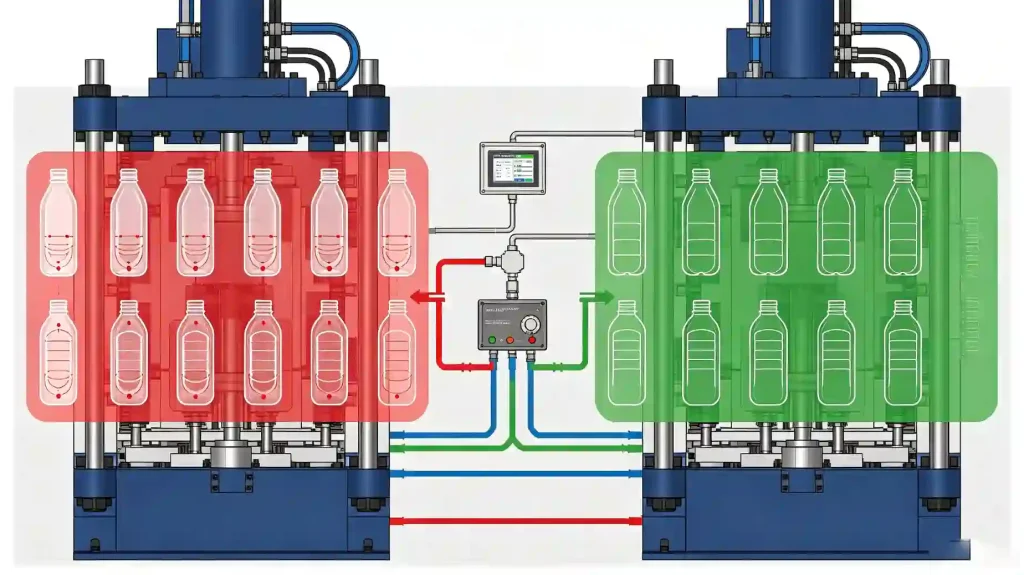
Comparison of Wall Thickness Consistency_ Hydraulic Presses vs. Servo Presses
Chemical Resistance (ESCR) of PET Pesticide Containers: Resin and Machine Interaction
Environmental stress crack resistance (ESCR) is the ability of a plastic container to resist cracking when simultaneously subjected to mechanical stress (internal pressure, external compression, closure torque) and a chemical environment. For pesticide containers, the chemical environment is the pesticide formulation itself — which may contain surfactants (highly ESCR-aggressive), solvents, or emulsifiers that accelerate stress cracking in PET.
| Pesticide Formulation Type | ESCR Risk Level | Recommended PET Resin IV | Machine Control Focus |
|---|---|---|---|
| Aqueous formulations (no surfactant) | Low | IV ≥ 0.72 dL/g (standard) | Standard wall thickness control; base zone ≥ 1.8mm |
| Emulsifiable concentrates (EC) with surfactants | Medium-High | IV ≥ 0.78 dL/g (ESCR grade) | Gate zone conditioning +15% above body; eliminate gate shadow; base wall ≥ 2.2mm |
| Solvent-based concentrates (SL, SC) | High | IV ≥ 0.82 dL/g or HDPE alternative | Maximum body wall thickness achievable; consider coextrusion or HDPE depending on solvent type |
The machine controls ESCR outcomes through two parameters: gate zone conditioning temperature (which determines residual stress at the gate area — the primary ESCR initiation point) and servo clamping position control (which prevents wall thinning at specific cavities that would create additional stress concentration points).
Gate area residual stress: The injection gate vestige on a PET pesticide bottle preform concentrates residual stress at the base center. If the gate zone is under-conditioned during blowing (gate area remains below optimal stretch temperature), the material at the gate does not orient — leaving a high-stress, low-orientation zone that is the first location to crack under ESCR conditions. On the HGA JS-series, the gate/base zone lamp output is increased to 18–22% above the body zone for pesticide container production (vs 10–15% for water bottles) specifically to drive adequate conditioning into this thick-wall zone.
Machine Model Selection for PET Pesticide Containers: Volume and Output Reference
Pesticide containers in PET span 100ml (small retail sachets) to 5L (bulk professional containers). The HGA JS-series covers this range across multiple cavity configurations:
| Model | Cavities | Max Volume (ml) | Max Body Ø (mm) | Output (bph) | Typical Pesticide Format |
|---|---|---|---|---|---|
| JS-4C76 | 4 | 700 | 68 | 4,800 | 100–500ml retail pesticide bottles (household insecticide, fungicide) |
| JS-4C114 | 4 | 1,300 | 94 | 3,300 | 500ml–1L professional pesticide concentrate |
| JS-2C130 | 2 | 1,500 | 110 | 1,800 | 1–1.5L agrochemical field spray concentrate |
| JS-2C200 | 2 | 5,000 | 180 | 1,600 | 2–5L bulk agrochemical (herbicide, fungicide concentrate) |
| JS-2C366 | 2 | 22,000 | 332 | 800 | 10–22L large-format agrochemical drum (institutional/farm supply) |
Frequently Asked Questions
▶ Does the blow molding machine need to be specified differently if the pesticide container will be exported to the EU vs domestic market?
▶ Can PET pesticide containers carry both liquid and solid (granule) formulations?
▶ Is in-mold labeling (IML) compatible with PET ISBM pesticide containers?
▶ What is the minimum wall thickness achievable for a 1L PET pesticide bottle on the JS-series machine?
Producing UN-certified agrochemical containers?
Share your container volume, packing group, formulation type, and wall thickness target — receive a machine model recommendation with UN test protocol support guidance.