
Semi-automatic PET stretch blow molding machines occupy a specific and well-defined position in the packaging equipment market: they are the correct tool for production volumes, container geometries, and operating environments where a fully automatic machine is economically unjustifiable and where manual production is insufficient for quality or output requirements. The decision between semi-automatic and automatic is not primarily about quality — a correctly set up semi-automatic machine produces bottles of equivalent optical clarity, wall thickness distribution, and neck finish precision to an automatic machine running the same preform. The decision is about throughput, operator labor cost, floor space, capital investment, and the flexibility to switch between container formats without mold changeover downtime. This article defines the operational envelope of semi-automatic PET blow molding, the scenarios where it is the correct specification, and the process parameters that determine bottle quality on a semi-automatic platform.
Semi-automatic vs fully automatic: the operational and economic decision boundary
Volume thresholds, format flexibility, capital cost, and labor requirements — where each machine type makes sense
A semi-automatic PET stretch blow molding machine separates the heating (conditioning) stage from the blowing stage — the operator loads preforms into the heater oven, transfers the heated preforms to the blow station, initiates the blow cycle (typically via a foot pedal or button), and removes the finished bottles. The key operational difference from a fully automatic machine is that the operator is in the critical path of the production cycle: if the operator is slow, inattentive, or unavailable, production stops. This operator dependency is the semi-automatic machine’s primary limitation — and also its primary advantage. The operator’s presence at the machine allows immediate visual inspection of every bottle at ejection, immediate response to any parameter drift, and rapid mold change without automated system reconfiguration. On a fully automatic machine, a mold change requires mechanical changeover of the preform handling, heating, and transfer systems as well as the blow mold; on a semi-automatic machine, the operator simply loads a different mold and adjusts the heater program — changeover time of 20–45 minutes vs 60–150 minutes for an automatic machine of equivalent cavity count.

The output rate of a semi-automatic machine is the primary factor that defines its market position. A single-cavity semi-automatic machine (the most common configuration for the HGA semi-automatic series) produces approximately 400–800 bph for 500ml bottles and 200–400 bph for 1.5–2L bottles — governed by the operator’s transfer speed between the heater and the blow station, and by the blow cycle time itself. A 2-cavity semi-automatic configuration doubles this output to 800–1,600 bph for 500ml bottles. Compare this with a fully automatic 4-cavity HGA JS-series machine at 4,800 bph for 500ml bottles — the automatic machine at 4 cavities produces 3–6× the output of the 2-cavity semi-automatic. The economic crossover point (where the capital cost premium of the automatic machine is justified by the labor cost saving and higher output revenue) depends on the local labor cost, the bottle selling price, and the annual production days. In markets with labor costs below approximately USD 5/hour (applicable to much of Southeast Asia, South Asia, and sub-Saharan Africa), the semi-automatic machine remains economically viable at annual production volumes of up to 3–5 million bottles per year before the automatic machine’s output advantage overcomes the capital cost premium.
Beyond the economic calculation, there are operational scenarios where semi-automatic is the technically correct choice regardless of economics. These include: R&D and prototype production, where container geometry changes are frequent and each change needs a small volume of bottles for evaluation; contract bottling operations where the order portfolio includes many SKUs at individually low volumes (semi-automatic allows economic production of 500–5,000 bottles per SKU without the mold investment and changeover cost of an automatic system); remote or off-grid production environments where compressed air supply capacity is limited (semi-automatic machines require less high-pressure air per hour because their cycle rate is lower); and emergency or backup production capacity, where a semi-automatic machine serves as redundancy for a primary automatic line.
Process parameters for semi-automatic machines: what changes vs automatic
Transfer time variability, heater dwell compensation, and how operator technique affects bottle quality
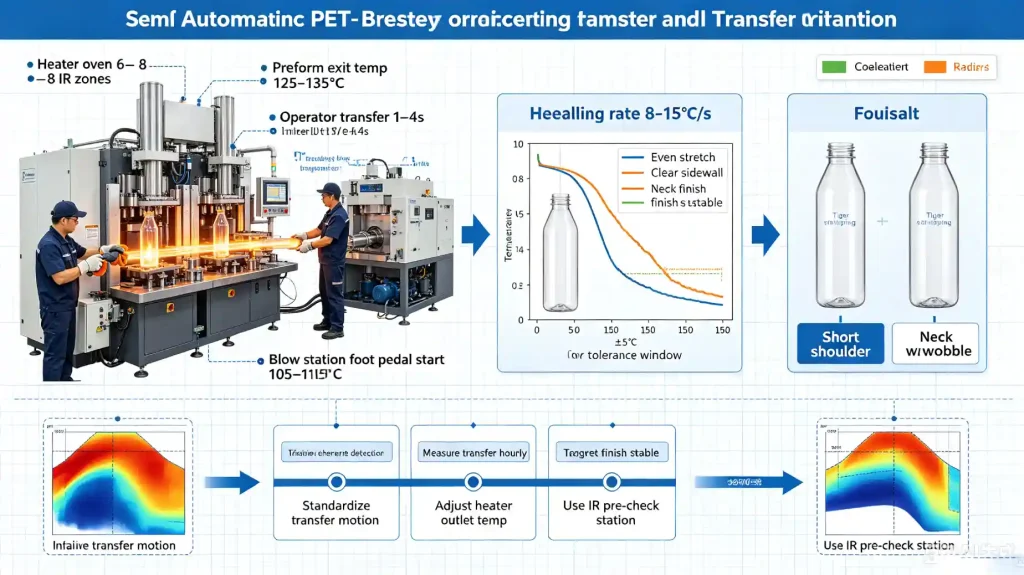
The central process challenge of semi-automatic PET blow molding is that the time between the preform leaving the heater oven and arriving at the blow station is variable — it depends on the operator’s movement speed. On a fully automatic machine, this transfer time is mechanically fixed (typically 0.5–1.5 seconds); on a semi-automatic machine, it can range from 1 second (fast operator) to 4–6 seconds (slow or fatigued operator). During this transfer time, the heated preform is cooling in ambient air — losing temperature at a rate of approximately 8–15°C per second depending on the preform wall thickness, body geometry, and ambient air temperature. A preform that exits the heater at the optimal blow temperature of 110°C and takes 2 seconds to reach the blow station arrives at 94–94°C — potentially 10–16°C below optimal. If the operator takes 4 seconds, arrival temperature may be 80–95°C — below the PET Tg of 72–76°C in the shoulder zone of a thin-wall preform, producing short-shot shoulders and wall thickness non-uniformity.
The compensation approach for transfer time variability is to set the heater oven outlet temperature higher than the optimal blow temperature by an amount that accounts for the expected cooling during transfer. For a semi-automatic machine where the average transfer time is 2.5 seconds: if the target blow temperature is 108°C and the cooling rate is 10°C/second for the preform geometry, the heater outlet temperature should be set at 108 + (2.5 × 10) = 133°C. This means the heform is slightly above the ideal blow temperature when it leaves the heater, and arrives at the blow station at approximately the correct temperature if the operator’s transfer time is close to the average. The problem is when the operator is significantly faster or slower than the average — a 1-second transfer produces a bottle blown at 123°C (too hot for 500ml bottle — shoulder over-stretch, potential tiger-striping on PET) and a 4-second transfer produces a bottle blown at 93°C (below Tg at the neck transition — short shoulder, base thinning).
The practical management of transfer time variability requires: (1) standardizing operator technique — the operator should use a fixed arm movement pattern and a consistent walking pace from heater to blow station; (2) measuring actual transfer time with a stopwatch at production start and at 1-hour intervals; (3) adjusting heater outlet temperature if the measured average transfer time changes by more than 0.5 seconds from the calibrated baseline (common as the operator tires over a shift); (4) for high-precision applications, installing a temperature measurement station between the heater exit and the blow station where the operator places the preform for 1 second before inserting into the blow mold — the station’s infrared thermometer measures the actual preform surface temperature and alerts the operator if it is outside ±5°C of the target before blowing.
The HGA semi-automatic machine series addresses transfer time variability through two design features: a dead-zone heater hold function (where the heater oven is set to a lower temperature for the last 20–30 seconds of the heating cycle, allowing the preform temperature to equilibrate through the wall before exit — reducing the temperature gradient that the preform enters the transfer period with), and an adjustable blow station pin position system (where the preform seating position in the blow mold can be adjusted in 0.5mm increments to compensate for dimensional changes in the preform neck caused by slight temperature variation in the transfer zone). These features do not eliminate transfer time variability as a quality factor, but they reduce its impact on bottle-to-bottle consistency.
Container formats and market segments for semi-automatic PET production
Which bottle types, volumes, and markets are best served by semi-automatic production
Semi-automatic PET blow molding machines cover the full volume range from 100ml (small condiment and pharmaceutical bottles) to 10–22L (large water jugs, chemical containers) — the volume range is constrained by the blow mold size that can be handled manually by the operator, not by the machine’s mechanical envelope. For large-format containers (5L and above), semi-automatic production has a specific advantage: the blow cycle time for large containers is dominated by the blow-hold dwell (25–40 seconds for 10–20L PET containers — see Application 3 large format chemical container article), and the operator’s transfer time is a small fraction of this dwell time. The output rate penalty of semi-automatic operation is minimal for large containers because the cycle time is already long; the economic case for a fully automatic large-format machine is correspondingly weaker.
The HGA semi-automatic series covers four key format categories: (1) Small containers 100–500ml — pharmaceutical bottles, condiment bottles, cosmetic containers, small beverage bottles for trial or boutique production. At 400–800 bph single-cavity, this is appropriate for batch sizes of 2,000–10,000 bottles per SKU. (2) Standard containers 500ml–2L — water bottles, beverage bottles, edible oil bottles for developing market or small-scale production. At 800–1,600 bph 2-cavity, appropriate for 5,000–20,000 bottles per batch. (3) Wide-mouth jars 50ml–2L — food jars, cosmetic jars, supplement jars with neck diameters up to 100mm. The semi-automatic platform handles wide-mouth formats particularly well because the operator can verify jar neck finish and seating surface quality by physical inspection at every cycle. (4) Large-format containers 3L–22L — water jugs, chemical containers, institutional food containers. At 200–600 bph single-cavity (governed by the blow-hold dwell requirement), appropriate for niche production volumes or as backup capacity alongside an automatic system.
HGA semi-automatic series: specifications and model selection
Machine envelope, utility requirements, and format capabilities
Frequently asked questions
Evaluating semi-automatic vs automatic for your PET bottle production?
Share your annual volume target, container format, local labor cost, and existing utility capacity — receive a semi-automatic vs automatic comparison with capital and operating cost analysis.