Description
Type: Spline Bore Yoke | Series: Agricultural PTO Shaft Parts | Cert: CE / ISO 9001:2015 | MOQ: 50 pcs
PTO Shaft Yoke-Product Introduction & Function
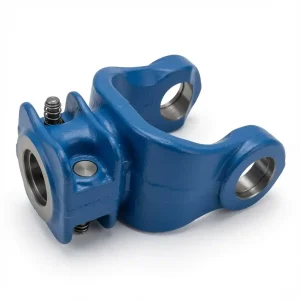
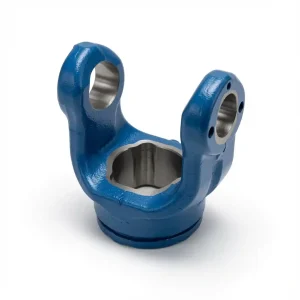
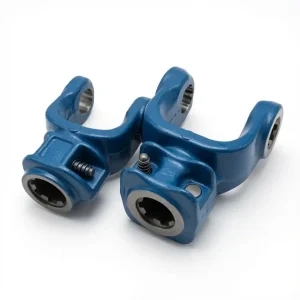
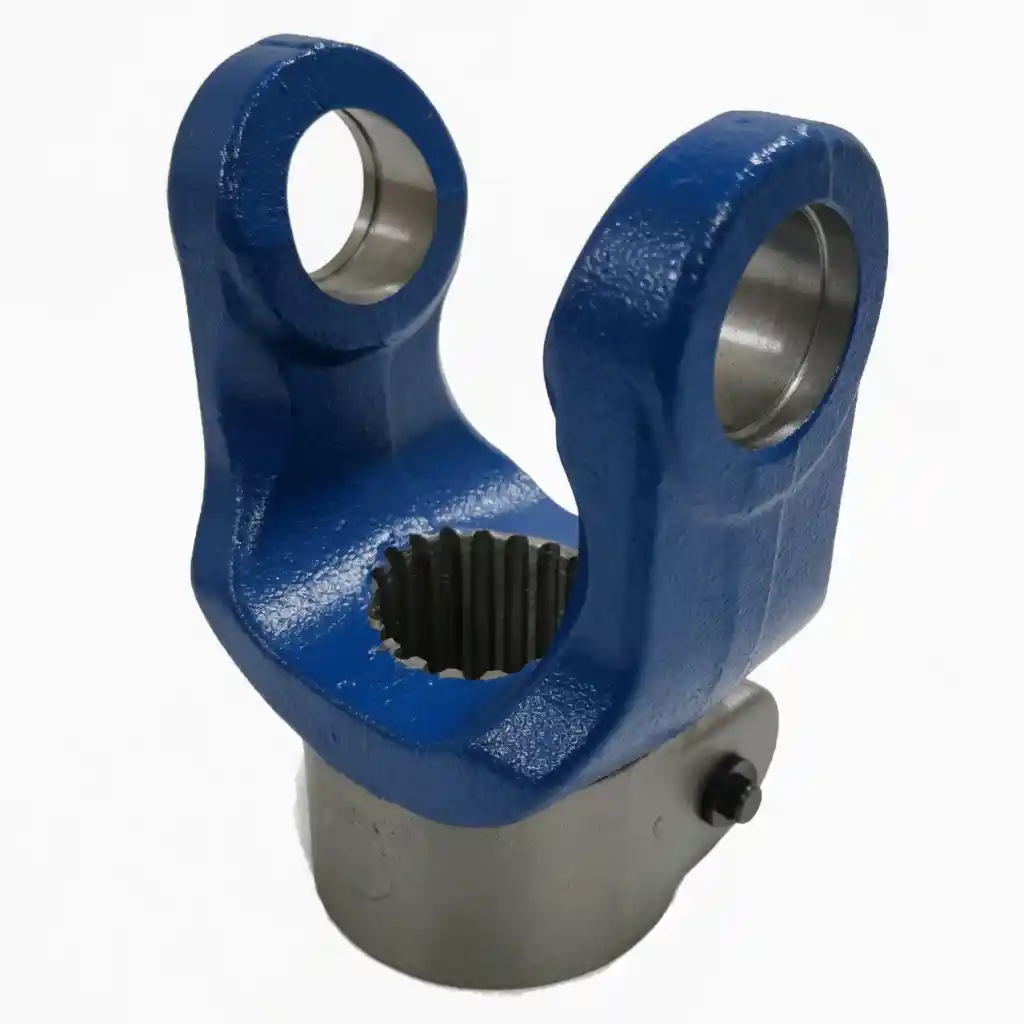
This PTO shaft yoke is a forged, spline-bore coupling component purpose-built for agricultural tractor drivelines. Its primary function is to connect the tractor’s power take-off (PTO) output stub shaft to the driveshaft assembly, transmitting rotational torque to attached implements such as rotary tillers, mowers, balers, and sprayers at standard operating speeds of 540 RPM or 1,000 RPM.
The spline PTO yoke uses an internally splined bore — available in the two most widely adopted profiles — to grip the tractor output shaft without set screws or clamp bolts. This splined interface distributes torque load across all tooth flanks simultaneously, eliminating the localized stress concentration that causes rapid wear on plain-bore yokes used under high cyclic loading. The yoke ears then accept a cross-kit universal joint, allowing the connected shafts to articulate up to ±35° while maintaining uninterrupted power transfer.
Forged from C45 medium-carbon steel and heat-treated to 58–62 HRC on spline and bearing contact surfaces, these yokes are tested to ISO 500 and EN 12965 dimensional standards. CE certification is available per batch, making them compliant for import into all 27 EU member states and compatible with EN 12965:2020 safety requirements. The global PTO shaft market is on track to reach USD 1.2 billion by 2028 at a 5.3% CAGR, reflecting strong ongoing demand for precision-made agricultural PTO universal joint yoke components from both OEM and aftermarket channels.
These yokes ship with phosphate-plus-oil surface treatment that passes 96-hour salt-spray testing (ISO 9227), keeping spline flanks and yoke arms corrosion-free through a full outdoor storage and transport cycle before first use.
PTO Shaft Yoke Key Specifications
| Parameter | Value |
|---|---|
| Product Type | Spline PTO Shaft Yoke — Agricultural Tractor Driveline |
| Bore Option A | 1 3/8″ × 6-Spline (ISO 500 Type 1 — 540 RPM) |
| Bore Option B | 1 3/8″ × 21-Spline (ISO 500 Type 2 — 1,000 RPM) |
| Material | C45 Forged Steel, Heat-Treated |
| Surface Hardness | 58–62 HRC on spline flanks and bearing seats |
| Spline Tolerance | DIN 5480 class e8/f7 (hobbed and shaved) |
| Bore Concentricity | ±0.02 mm |
| Rated Torque @ 540 RPM | 460 N·m / 35 HP (Series 4 standard) |
| Surface Finish | Phosphating + Oil Seal (96-hr ISO 9227 salt-spray pass) |
| Compatible Cross-Kit | 27 mm × 74.6 mm Series 4 (Eurocardan / Weasler / G&G) |
| Certification | CE (EN 12965:2020), ISO 9001:2015 |
| MOQ / Lead Time | 50 pcs / 7–15 business days standard; OEM from 200 pcs |
How to Replace Yoke on PTO Shaft
A worn spline bore, cracked yoke arm, or damaged cross-kit seat calls for immediate PTO shaft yoke replacement. Delaying repairs accelerates damage to the tractor stub shaft and implement gearbox. The procedure below covers a standard spline-bore tractor-end yoke on a Series 4 driveline. Estimated bench time: 20–40 minutes.
Safety Requirement — Stop Before You Start
Park on level ground, engage the parking brake, shut off the engine completely, and wait for all shaft rotation to cease. Never service a live PTO shaft. If the implement is raised, support it mechanically — hydraulic pressure can drop without warning.
- Disconnect the driveline from the tractor. Release the slide collar or quick-release ring on the tractor-end yoke and pull the shaft straight off the PTO stub. Lay the assembly on a clean workbench. If the spline bore has seized onto the stub shaft, do not pry — apply penetrating oil and wait 10 minutes before attempting removal.
- Remove the four circlips. Using circlip pliers, extract all four retaining circlips from the yoke ears. Set them aside in a labeled container — reuse only if they show no distortion or flat spots. New circlips cost under $1 per set; worn ones cause cup ejection failures.
- Press the bearing cups out of the yoke ears. Position the yoke so one cup faces upward with the opposite pair of ears resting on a vice jaw. Strike the yoke body downward with a mallet — the lower cup advances. Rotate 180° and repeat for the remaining cup. Place each removed cup in a labeled bag with its needle bearings intact (20–22 needles per trunnion). Never intermix needles from different cups.
- Disengage the cross trunnion and remove the old yoke. With both cups free, slide the cross trunnion clear of the damaged yoke ears. Inspect the shaft tube end for deformed splines, scoring, or raised burrs. Remove any burrs with a fine file before fitting the replacement.
- Verify the new yoke dimensions. Before pressing anything together, confirm the replacement spline PTO yoke matches: bore size (1 3/8″), spline count (6 or 21), and cross-kit ear bore diameter (27 mm for Series 4). A mismatched yoke will fail within the first 10 hours of operation. Cross-reference against your tractor’s specification sheet or the part number on the damaged yoke.
- Pack the new cups and install the cross-kit. Fill each bearing cup to 70–80% capacity with NLGI #2 EP grease — overfilling causes seal blow-out. Using a socket matched to the cup outer diameter, press each cup into the new yoke ear until the circlip groove is fully exposed. Install new circlips and verify they seat completely in their grooves by attempting to retract them with a flat screwdriver. Any circlip that lifts out under light force is not seated and must be re-pressed.
- Reconnect and run a function test. Slide the assembled yoke onto the tractor PTO stub shaft until the collar or quick-release ring locks audibly. Raise and lower the three-point hitch through its full range to verify driveline clearance and angle. Engage the PTO at low idle (800–1,000 engine RPM) for 2 minutes and listen for vibration, knocking, or heat generation at the yoke area before returning to normal working speed.
Always replace the yoke and cross-kit as a matched set. Fitting a new yoke against a worn cross produces metal-to-metal contact on mismatched hardness surfaces, cutting effective service life of the new part by up to 40%.
Applications of PTO Shaft Yoke in Agricultural Machinery
The spline PTO shaft yoke is the starting point of every tractor-driven implement driveline. Because the 1 3/8″ × 6-spline profile is standardized across ISO 500 Type-1 tractors — representing over 80% of compact and utility tractors under 100 HP manufactured globally since 1980 — a single yoke specification covers the majority of farm equipment requiring a high torque PTO shaft yoke for farm equipment across these categories:
| Implement | PTO Speed | Why This Yoke Fits |
|---|---|---|
| Rotary Tillers / Rotavators | 540 RPM | Absorbs soil-impact shock loads; hardened splines resist fretting in stony ground |
| Finish Mowers & Rotary Cutters | 540 RPM | Sustains 460 N·m continuous torque; low runout reduces blade vibration |
| Round & Square Balers | 540–1,000 RPM | 6–10 hr/day continuous duty; forged body handles cyclic peak torque spikes at chamber fill |
| Fertilizer Spreaders & Sprayers | 540 RPM | Phosphate + oil coating resists fertilizer and chemical corrosion between seasons |
| Post Hole Diggers | 540 RPM | Handles repeated high-torque stall events (rock strike); 120,000 N·mm bending moment rating |
| Grain Augers & Conveyors | 540–1,000 RPM | Smooth power transfer at sustained high speed; minimal vibration protects auger bearings |
| Irrigation Pumps | 540–1,000 RPM | Runs 4–12 hr uninterrupted; sealed bearing cups maintain lubrication without daily re-greasing |
| Wood Chippers | 540–1,000 RPM | Extreme shock tolerance; forged grain structure withstands sudden jam-stop inertia loads |
| Flail Mowers & Mulchers | 540 RPM | Debris resistance and secure bore fit critical in high-debris mulching environments |
Across all categories, the spline interface on this PTO universal joint yoke ensures torque is transmitted through geometry, not friction — meaning connection force and wear are predictable, replaceable, and never reliant on bolt pre-load that can relax in field vibration.
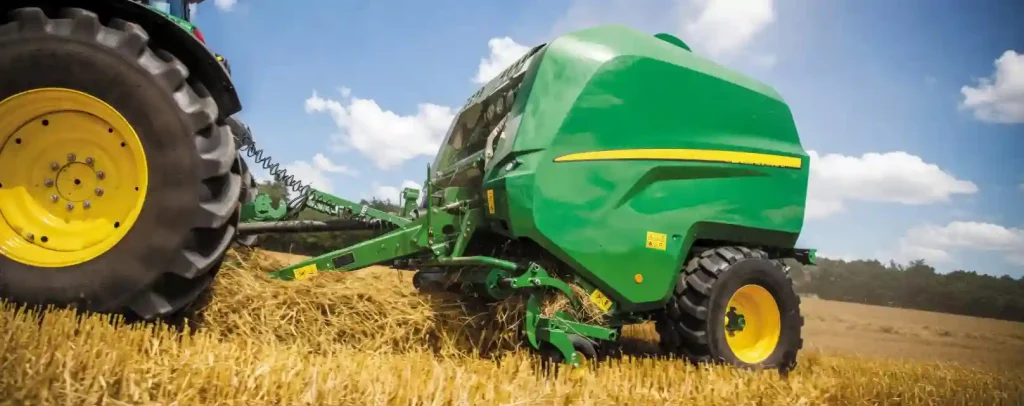
Maintenance and Care of Agricultural Power Take-Off (PTO) Shaft Yokes
Correct maintenance is the single largest factor in yoke service life. Field data indicates that most premature yoke failures trace back to three causes: inadequate lubrication, operating beyond the rated articulation angle, and delayed replacement of worn cross-kits. The schedule and procedures below address all three.
1. Lubrication Schedule
- Universal joint / cross-kit: Grease every 8–10 operating hours using NLGI #2 EP lithium grease. Pump until fresh grease purges from all four trunnion seals — not just one or two. Partial purge means one bearing race is still running dry.
- Spline bore and telescoping tube: Clean and re-grease every 40–50 operating hours, or whenever the implement is detached. Wipe spline flanks with a clean rag before applying fresh grease to prevent abrasive buildup from accelerating flank wear.
- Dusty or wet operating conditions: Halve the intervals above — grease cross-kits every 4 hours and splines every 20–25 hours. Contaminant ingression is the leading cause of needle bearing fatigue in field environments.
2. Seasonal Inspection Checklist
Perform a thorough inspection at least once per season or every 250 operating hours, whichever comes first:
- Yoke arms: Check for cracks, bends, or visible surface fatigue at the root fillets — the transition zone from ear to body is the highest-stress area. Any crack at this location requires immediate replacement; do not attempt to weld-repair load-bearing yoke arms.
- Spline bore: Insert the tractor stub shaft and attempt to rock it radially. Any perceptible backlash beyond 0.3 mm under hand force indicates spline flank wear; replacement is needed before the next season to prevent fretting damage to the tractor output shaft.
- Cross-kit radial play: Grasp each trunnion pair and attempt to rock perpendicular to the rotation axis. Any detectable radial movement — even 0.5 mm — means needle bearings have flattened and the cross-kit must be replaced. Running a worn cross rapidly scores the yoke ear bore, turning a $15 part failure into a $60+ yoke replacement.
- Safety shield: Verify the guard rotates freely on its bearing, that no cracks or holes are visible, and that the safety chain anchor is intact. A seized or missing shield is a regulatory non-compliance issue under EN 12965 and ASABE S619.
- Surface corrosion: Light surface rust on non-contact surfaces is cosmetic. Rust penetrating the spline flanks or yoke ear bores requires parts replacement, not wire-brushing, as pitting reduces fatigue resistance below rated values.
3. Operating Angle and Alignment
- Keep the PTO shaft operating angle below 15° at working height for maximum cross-kit life. Velocity fluctuation — and the vibration it causes — increases proportionally with angle above 15°.
- At transport height with the implement fully raised, the driveline may briefly exceed 25°. This is acceptable if it lasts less than 60 seconds per field crossing. Sustained operation above 25° at rated RPM compresses bearing cup life by up to 60%.
- Ensure the telescoping tube maintains a minimum 150 mm overlap in the fully extended working position. Running out of overlap allows the shaft to separate at speed — a catastrophic safety event.
4. Off-Season Storage
- Clean all grease fittings and tube surfaces before storage. Old grease left in cross-kit cups can harden and restrict bearing movement, leading to dry start-up damage on the first use of the following season.
- Apply a light coat of anti-corrosion spray to exposed spline bores and yoke ear bores before storing the shaft in a dry location. Hanging storage (vertical orientation) prevents plastic guard deformation and keeps the telescoping tube from retaining moisture.
- Tag any component identified for replacement during the seasonal inspection and order parts before the next working season — not after the shaft fails in the field during peak harvest.
Frequently Asked Questions
Q1: What is the difference between a 6-spline and a 21-spline PTO shaft yoke?
6-spline yokes fit Type-1 PTO outputs running at 540 RPM (up to ~75 HP). 21-spline yokes fit Type-2 outputs at 1,000 RPM for higher-power applications. Mixing the two damages both the yoke and the tractor stub shaft. Always confirm your tractor’s spline count before ordering.
Q2: How do I know when a PTO shaft yoke replacement is needed?
Replace the yoke if you detect: radial spline play above 0.3 mm, visible cracks on yoke arms, bore scoring from a worn cross-kit, or rhythmic vibration at PTO engagement RPM. Replace the cross-kit at the same time — a new yoke against a worn cross reduces service life by up to 40%.
Q3: Is this a high torque PTO shaft yoke suitable for heavy farm equipment?
Yes. The forged C45 body sustains 460 N·m at 540 RPM (Series 4) and a bending moment of ≥120,000 N·mm without deformation. It covers balers, rotary cutters, and wood chippers up to 75 HP. For equipment above 75 HP, specify Series 5 or 6 in your enquiry.
Q4: How often should I grease the PTO universal joint yoke?
Grease cross-kit bearings every 8–10 operating hours using NLGI #2 EP grease. In dusty or wet fields, reduce to every 4 hours. Re-grease spline bores every 40–50 hours or at each implement change. Pump until fresh grease exits all four trunnion seals.
Q5: What MOQ is available, and can OEM markings be applied?
Standard MOQ is 50 pcs for stock 6-spline or 21-spline versions. OEM orders — custom bore, laser marking, alternative surface treatment, or bespoke packaging — are available from 200 pcs with a 25–35 day sample and tooling lead time. CE documentation provided per lot.
Commonly Used Companion Products
The PTO shaft yoke is one component in a complete driveline assembly. The following parts are routinely sourced alongside it by implement OEMs, farm equipment distributors, and wholesale workshops:
Cross & Universal Joint Kit
20CrMnTi carburized cross, 27 mm × 74.6 mm (Series 4). Replace with the yoke — mismatched hardness between old and new components cuts the service life of the newer part by up to 40%.
PTO Driveshaft Tubing
Round, lemon, or trilobular inner/outer telescoping tube pairs in Q345 steel. Minimum 150 mm overlap at full implement raise. Available in cut lengths or pre-matched to yoke series.
Implement End Yoke
Fixed yoke at the gearbox input — round bore, splined bore, square bore, or weld-on stub configurations. Must match the implement’s input shaft profile; specify bore size and keyway dimensions when ordering.
Slip Clutch / Torque Limiter
Friction-disc clutch preset to slip at 150–500 N·m depending on implement rating. Protects the yoke and gearbox from sudden overload on rock strikes or implement jam events — particularly critical for post-hole diggers and wood chippers.
Get Factory-Direct Pricing on Spline PTO Shaft Yokes — From 50 pcs
We supply forged, CE-documented PTO shaft yokes with batch dimensional inspection reports — ready for EU customs clearance and compatible with the full range of ISO 500 Type-1 and Type-2 tractor drivelines. Standard configurations ship in 7–15 business days. OEM branding and custom bore options from 200 pcs.
MOQ 50 pcs · CE EN 12965:2020 + ISO 9001:2015 · Batch inspection records included · OEM / ODM from 200 pcs