Descrizione
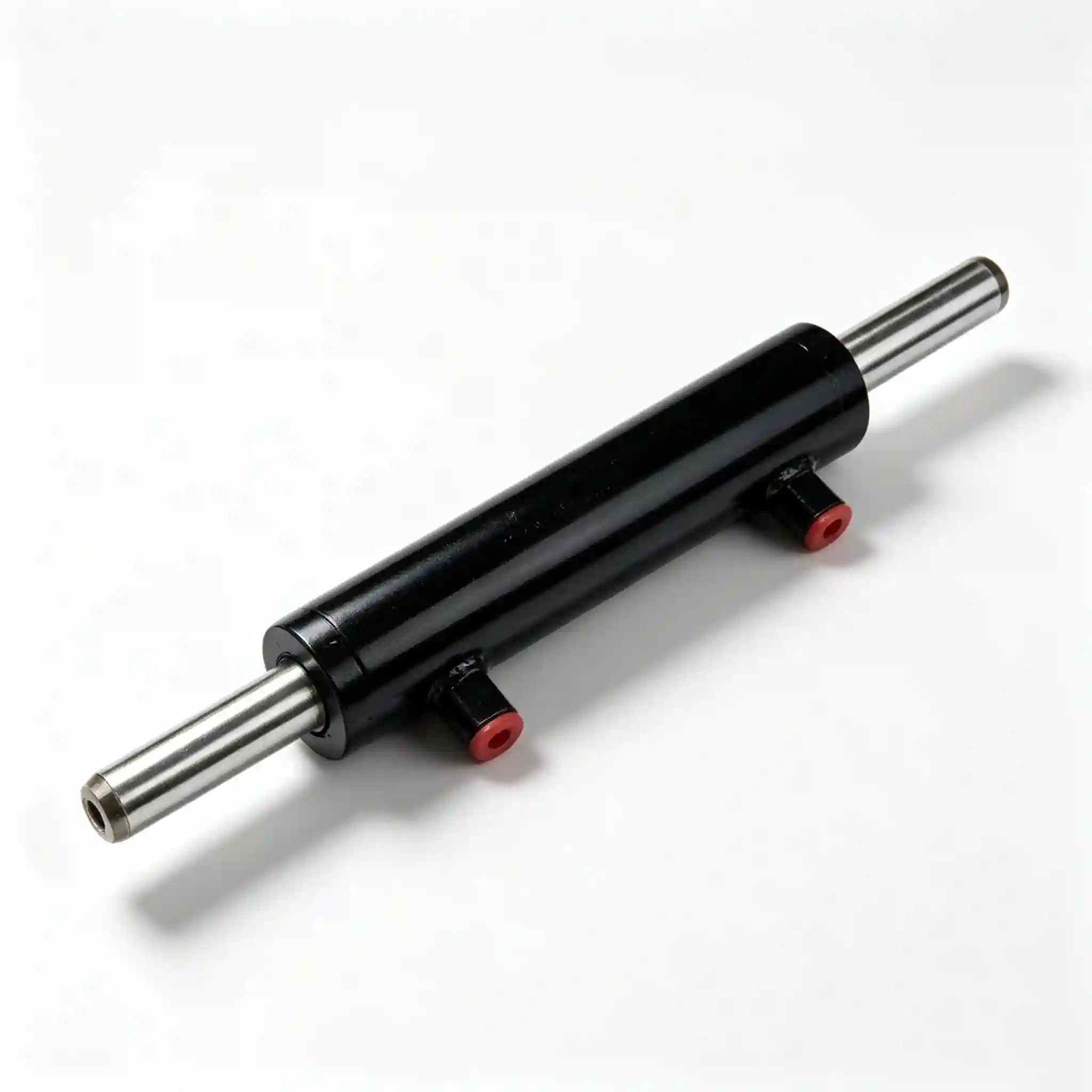
MWTEHX-2101043 Tractor Power Steering Cylinder — 40 mm Bore × 200 mm Stroke Long-Travel OEM Steering Ram
| OEM Part Number | MWTEHX-2101043 |
| Bore Diameter | 40 mm |
| Rod Diameter | 27 mm |
| Stroke | 200 mm |
| Mounting Distance (C-C) | 460 mm |
| Cylinder Type | Double-Acting, Welded or Tie-Rod |
| Applicazione | Agricultural Tractor Power Steering Circuit |
| Seal Material | Polyurethane (PU) + NBR Backup |
Enquire Now — Volume Pricing Available
OEM fitment verified · MOQ 10 units · FOB Ningbo or Shanghai
Engineering Overview: MWTEHX-2101043 Long-Travel 200 mm Stroke Tractor Hydraulic Power Steering Cylinder for Mid-Range Front Axle Geometry
The MWTEHX-2101043 Tractor Power Steering Cylinder serves a distinct engineering purpose within the agricultural hydraulic steering segment: it combines a compact 40 mm bore with an extended 200 mm stroke, yielding a stroke-to-bore ratio of 5.0:1 that is markedly higher than the typical 3.0–4.0:1 ratio found in smaller tractor steering rams. This extended stroke reflects the wider front-axle track width typical of mid-range tractors in the 40–65 hp class, where the steering arm sweep arc requires a greater cylinder travel distance to achieve the designed lock-to-lock wheel angle without modifying the steering arm geometry or introducing Ackermann error.
The MWTEHX prefix code follows a Midwest agricultural equipment supplier part-numbering convention. “MWTE” denotes the tractor equipment family, “HX” identifies the hydraulic steering subcategory, and “2101043” is the sequential product identifier tying back to engineering drawings held at the original equipment design authority. Fleet maintenance managers operating mixed fleets of mid-range agricultural tractors produced under MWTEHX-designated engineering standards will find this cylinder essential for line-fit replacement, as the 460 mm C-C mounting distance and 27 mm rod diameter form a matched-pair specification with the steering arm pin bores and drag link dimensions on the target chassis family.
The 200 mm stroke differentiates this cylinder from the ZY254.31F.019A and other 140–160 mm stroke variants used on lighter machines. A larger stroke demands a more rigid piston rod to resist buckling under compressive loads. This is addressed by the 27 mm rod diameter—chosen to achieve a rod slenderness ratio below 100 at full extension, keeping the rod safely within Euler’s column buckling limits at operating pressures up to 16 MPa. For procurement engineers, this means the MWTEHX-2101043 is not a generic 40 mm bore cylinder available from commodity stock; it is a dimensionally specific component for which incorrect substitution with a shorter-stroke or smaller-rod variant will result in measurable steering performance degradation.
Primary applications include medium-size two-wheel-drive and four-wheel-drive agricultural tractors used for row-crop cultivation, orchard management, and field preparation in markets including Australia, the United Kingdom, the Netherlands, and Brazil, where the MWTEHX engineering series has established distributor supply chains. The 460 mm mounting distance is also found on several export-market tractors produced under OEM licensing from Chinese manufacturers for South American agricultural applications.

Structural Specifications: Bore/Rod Ratio Analysis, Hydraulic Fluid Velocity, and Seal Kit Configuration for the 40 mm × 200 mm Hydraulic Steering Cylinder
With a bore area of 1,257 mm² and a rod area of 573 mm² (based on the 27 mm rod), the MWTEHX-2101043 produces a bore-to-rod area ratio of approximately 2.19:1. This ratio is lower than the ZY254.31F.019A’s 2.56:1, reflecting the larger rod diameter. The practical consequence is a smaller differential between extend and retract force: at 12 MPa operating pressure, the extension force is approximately 15.1 kN and the retract force is approximately 8.2 kN—a retract-to-extend ratio of 54%, which is characteristic of steering cylinders where balanced feel in both steering directions is important for operator confidence on mixed-terrain surfaces.
The 200 mm stroke introduces a hydraulic fluid volume consideration that shorter-stroke cylinders do not present. Full extension displaces approximately 251 cm³ from the barrel end port; full retraction displaces approximately 115 cm³ from the rod end port (accounting for rod displacement volume). The tractor’s power steering pump must supply this volume at a flow rate that achieves the designed steering lock speed—typically 1.5–2.5 seconds from centre to full lock in standard tractor power steering circuits. For a 2.0-second lock time, the minimum required pump flow rate is approximately 7.5 L/min, a figure that falls within the operating range of most tractor-mounted gear pumps at mid-idle speed.
The cylinder barrel is produced from GB/T 8713-grade precision-drawn seamless steel tubing, specifically 20# steel grade with a minimum yield strength of 245 MPa and tensile strength of 410–550 MPa. The internal bore is finish-honed to Ra ≤ 0.4 µm over the full 200 mm stroke length—an important quality parameter, since longer stroke lengths present greater risk of honing taper at the ends of the bore travel, which would create progressive piston seal stress that is not present in the middle of the stroke range. Batch dimensional inspection uses a calibrated air gauge to measure bore diameter at three axial positions: 10 mm from each end and at mid-stroke, with the acceptance criterion set at ≤0.015 mm taper.
The 27 mm rod is manufactured from 40Cr alloy steel (equivalent to AISI 5140), heat-treated to a core hardness of 28–32 HRC before hard chrome plating. The alloy steel base—rather than 45# carbon steel used in lighter cylinders—provides the higher fatigue limit needed for the longer stroke, where the rod cycles through a greater fraction of its total length per steering movement, accumulating more fatigue cycles per hour of operation than an equivalent shorter-stroke rod would. The chrome plating specification is 25–30 µm total thickness, slightly thicker than the ZY254.31F.019A rod, to accommodate the additional length of exposed rod surface that is subject to atmospheric corrosion when the cylinder is in retracted positions during storage or transport.
The seal kit for the MWTEHX-2101043 comprises a PU piston U-ring as primary piston seal, an NBR O-ring as piston secondary seal, a PU rod U-seal, and a polyester-reinforced wiper seal at the gland. The wiper seal reinforcement—a polyester fabric backing bonded to the PU lip—is specified for this cylinder due to the longer exposed rod length that accumulates more dust and plant material in open-field operation, requiring a wiper with greater abrasive scraping capacity than a simple PU lip wiper would provide.
OEM Cross-Reference and Front Axle Fitment Guide: 460 mm Mounting Distance Hydraulic Power Steering Cylinder for Tractor Steering Arm Clearance Verification
The 460 mm centre-to-centre mounting distance of the MWTEHX-2101043 is measured between the centre of the barrel-end clevis pin and the centre of the rod-end clevis pin with the cylinder in the fully retracted position. This retracted C-C dimension defines the chassis hard point to which the cylinder attaches; the steering arm pivot and axle bracket are fixed structures that cannot be adjusted in service. Measuring the retracted C-C distance on the original cylinder before removal—or referencing the chassis drawing if the original cylinder has already been discarded—is the mandatory first step in fitment verification for this replacement part.
Clevis pin hole diameters on the MWTEHX-2101043 are bored to 25 mm H7 tolerance at both ends. This matches the 25f7 steering arm pins used on the MWTEHX-series front axle design. A 25 mm pin specification is notably larger than the 22 mm pin used on the ZY254.31F.019A, reflecting the higher lateral load capacity required by the longer stroke and heavier steering geometry of the mid-range tractor chassis. Attempting to interchange these two cylinders on a non-matching chassis—fitting the smaller-pin ZY254.31F.019A to an MWTEHX-specification axle or vice versa—will either produce an undersized pin that creates destructive pin-to-bore impact loading, or an oversized pin that cannot be inserted into the clevis hole without damaging the bore finish.
For OEM procurement and fleet parts management, the MWTEHX-2101043 is cross-referenced against several equivalent part numbers used by regional distributors. Buyers should verify the four-parameter dimensional signature: 40 mm bore, 27 mm rod, 200 mm stroke, 460 mm C-C. Third-party suppliers offering “equivalent” cylinders often substitute a 25 mm rod for the 27 mm rod to reduce material cost—a change that decreases the rod section modulus by approximately 30% and reduces fatigue life under identical operating conditions. Specification verification at the dimensional certification level, not just the visual appearance of the product, is the critical procurement safeguard for fleet buyers.
Extended-reach applications—specifically tractors with aftermarket front axle widening kits for wide-row crop clearance—may require a modified stroke variant. Our engineering team can supply MWTEHX-series cylinders in stroke increments of ±20 mm from the standard 200 mm, accommodating track widths up to approximately 1,800 mm rear-equivalent front-axle settings while maintaining the same 460 mm retracted C-C mounting distance through adjustment of the clevis thread engagement depth.
Step-by-Step Installation Guidance, Alignment Torque Specification, and Hydraulic Seal Replacement Cycles for the 200 mm Stroke Tractor Steering Cylinder
Prior to installation, prepare the mounting surfaces on both the axle bracket and the steering arm. Clean all pin bores with a brass brush and inspect for wear. A worn pin bore on the axle bracket—identified by an oval or egg-shaped bore section when measured with an internal calliper at 0° and 90°—should be rebushed with a bronze sleeve pressed to restore the 25 mm H7 bore. Installing a new cylinder against a worn bracket bore transfers the wear-induced impact load directly into the new cylinder’s clevis, accelerating fatigue crack initiation at the clevis root within a fraction of the cylinder’s design service life.
The cylinder should be installed in a near-horizontal orientation, with the barrel-end below the rod-end if a slight tilt is present. This orientation ensures that any air in the circuit migrates toward the highest point—the rod-end port—and can be bled from the system during the post-installation bleed cycle. Installations where the barrel is elevated and the rod is below horizontal are susceptible to air pockets trapping in the barrel-end cap, causing spongy steering feel that does not resolve without a full circuit drain-and-refill.
Torque the clevis pin retention fasteners to 45–50 N·m at the barrel end and 35–40 N·m at the rod end. The lower rod-end torque prevents over-compression of any nylon lock nut or split pin castle nut that may interfere with the free articulation of the rod-end joint. After tightening, manually push the front wheels through their steering arc—before connecting the hydraulic hoses—to confirm that the cylinder moves smoothly through its full stroke without binding, hesitation, or axial misalignment-induced lateral force on the rod.
Hydraulic hose connections: use M16×1.5 or equivalent port standard fittings with new copper crush washers or bonded seals. Do not reuse the original sealing washers, as they deform plastically during initial torquing and will not reseal reliably under system pressure. Torque M16 fittings to 55–65 N·m. After connection, bleed the circuit by cycling from lock to lock slowly at least five times with the engine at low idle. Confirm that the fluid level in the reservoir remains stable and that no air bubbles appear in the reservoir return line. Steering feel should be firm and consistent by the end of the third full lock-to-lock cycle.
The extended 200 mm stroke means the rod wiper seal traverses a greater length of exposed rod per lock-to-lock cycle compared to shorter-stroke units. In dusty or sandy field conditions, inspect the wiper seal visually at every 500-hour service interval. Observable symptoms of wiper seal degradation include: a continuous grey-brown film of dust on the rod at the gland exit point; oil residue accumulating at the gland face; or a faint groove pattern visible on the chrome rod surface at the maximum extension position, indicating embedded abrasive particles in the wiper lip. Replace the full seal kit when any of these indicators are present—do not wait for visible external leakage, as piston seal damage typically predates external rod seal leakage in agricultural environments with high particulate loading.
Factory Inspection Protocols, Salt Spray Corrosion Testing, and Bulk Order Procurement Terms for the MWTEHX-2101043 Agricultural Steering Cylinder
The MWTEHX-2101043 undergoes a three-stage quality inspection sequence before packing. Stage one: dimensional inspection using calibrated gauge tools—bore diameter checked with a 40 mm air plug gauge, rod diameter with a bench micrometer, stroke confirmed against a go/no-go length fixture, and C-C distance measured with a digital vernier from clevis-pin-centre to clevis-pin-centre in the retracted position. All four measurements must fall within the tolerances specified in the engineering drawing before the unit proceeds to Stage two.
Stage two: pressure integrity test. The cylinder is connected to a dedicated test rig and pressurised to 21 MPa (1.5× the 14 MPa rated working pressure) for 5 minutes at full extension and 5 minutes at full retraction. External leakage is checked at all ports, the gland seal, and the barrel welds (if welded construction). Any seepage beyond 0 drops per minute results in immediate rejection. Additionally, the internal leakage across the piston seal is measured by pressurising one port while the other is connected to a burette; acceptable internal leakage is ≤2 mL per minute at rated pressure. Units exceeding this threshold indicate a piston seal defect or bore honing irregularity and are rejected for teardown analysis.
Stage three: surface finish and corrosion inspection. Chrome rod surface is visually inspected under 10× magnification for pitting, micro-cracks, or coating defects. A sample of chrome rods from each production batch is subjected to 240-hour ASTM B117 salt spray testing. The outer barrel finish—typically an epoxy-based industrial primer coating in black or grey—is inspected for coverage completeness over all weld seams and port threads. Inadequate coating coverage at weld heat-affected zones is a documented initiation site for pitting corrosion in high-humidity storage conditions encountered during long-duration ocean freight.
Export packaging for the MWTEHX-2101043 uses an individual corrugated carton with foam end-cap inserts to protect the clevis pins and rod surface during transit. Each unit is wrapped in VCI (Vapour Corrosion Inhibitor) poly film before boxing, providing 24-month corrosion protection for sea freight and warehouse storage. Pallet quantities of 40 units are stretch-wrapped and banded for container loading. Full container loads (FCL) of 20′ dry containers accommodate approximately 800–900 units depending on pallet configuration, a quantity that suits regional distributor stocking programs for markets with established MWTEHX-series tractor populations.
For OEM buyers requiring custom integration, the MWTEHX-2101043 platform accepts modifications including: alternative port face orientations (side port, end port, or custom angular port), non-standard clevis pin bore diameters in 1 mm increments between 20–32 mm, alternative seal materials (FKM/Viton for high-temperature applications above 80°C), and surface treatment upgrades to electroless nickel plating on the barrel exterior for corrosive marine-adjacent agricultural environments. Engineering review for custom specifications requires a completed technical questionnaire and 2D drawing; standard custom lead time is 25–35 days FOB.
Request a Quote: MWTEHX-2101043 Tractor Power Steering Cylinder
OEM and distribution buyers can submit a quote request with target quantity, destination port, and any custom dimension requirements. Our engineering team will confirm fitment compatibility against your chassis drawing before order confirmation.
MOQ: 10 units | Lead time: 7–15 days FOB | Custom port/clevis options: 25–35 days