
Cavity count on an injection stretch blow molding machine is not a performance specification — it is a production planning output. The correct cavity count is the one that matches your actual bottle-per-hour requirement at the right operating efficiency margin, without carrying unnecessary capital cost in excess capacity or running into output shortfalls on peak days. This guide works through the calculation from daily production target to machine model specification.
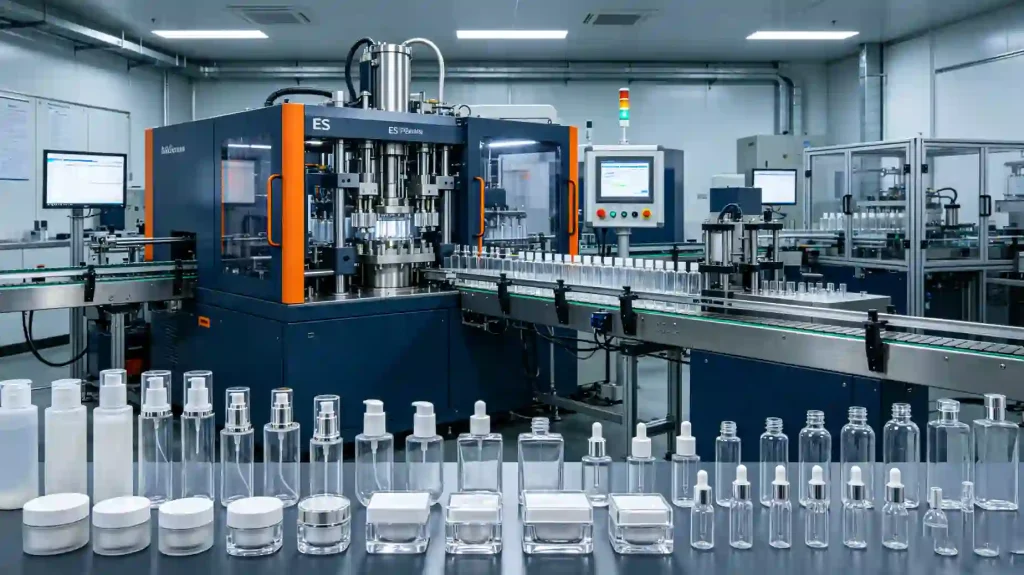
Step 1 — Convert Your Production Target Into a BPH Requirement
Input parameters required before opening any machine specification sheet:
| Parameter | Example Value | Notes |
|---|---|---|
| Weekly production target | 200,000 bottles | From sales forecast or confirmed order volume |
| Production days per week | 5 days | Or 6 if weekend running is planned |
| Production hours per day | 16 hours | Two 8-hour shifts |
| Target OEE | 82% | Adjust based on facility standard |
| Startup scrap allocation | 1.5% | Startup and changeover waste |
| Steady-state scrap rate | 1.2% | For servo-drive cosmetic bottle production |
BPH Calculation (using example values above):
| Gross BPH required | = Weekly target ÷ (days × hours/day × OEE) | = 200,000 ÷ (5 × 16 × 0.82) = 3,049 bph |
| Add scrap allowance | × (1 + 0.012 + 0.005) = × 1.017 | → 3,100 BPH minimum specification |
Round up to the next available machine configuration output level — this is your minimum specification BPH. Never build a production plan that requires 100% OEE to meet the target.
Step 2 — Map BPH Requirement Against the HGA Machine Range
| Model | Cavities | Max Volume (ml) | Output (bph) | Best Fit |
|---|---|---|---|---|
| HGA.ES-2C100 | 2 | 500 | 2,400 | Small cosmetic, serum bottles |
| HGA.ES-2C114.3 | 2 | 1,000 | 2,000 | Lotion, conditioner, 1L format |
| HGA.ES-3C76 | 3 | 700 | 3,000 | Mid-volume cosmetic, 500–700ml |
| HGA.ES-3C114 | 3 | 1,500 | 2,400 | 1L+ shampoo and conditioner |
| HGA.ES-4C76 | 4 | 700 | 4,800 | High-volume small cosmetic bottles |
| HGA.ES-4C100 | 4 | 800 | 4,600 | High-volume 500–800ml cosmetic |
| HGA.ES-4C114.3 | 4 | 1,000 | 4,000 | Standard 1L cosmetic and personal care |
| HGA.ES-6C76 | 6 | 700 | 7,200 | Maximum output small cosmetic format |
| HGA.FS-1CG130 | 1 | 1,500 | 700 | Irregular geometry, specialty |
| HGA.FS-2CG220 | 2 | 5,000 | 1,000 | 2-cavity irregular geometry |
Step 3 — Account for Multiple SKU Changeovers
A cosmetic bottle line rarely runs a single SKU continuously. Each mold changeover reduces effective production time available. Ignoring this step when specifying cavity count is the most common reason a machine appears undersized after delivery.
Changeover time by cavity count (2-person trained crew):
| Configuration | Changeover Duration | 5 changeovers/week |
|---|---|---|
| 2-cavity ES mold | 60–90 min | 5–7.5 hrs lost/week |
| 4-cavity ES mold | 90–150 min | 7.5–12.5 hrs lost/week |
Revised BPH calculation with 5 changeovers/week at 2 hours each:
| Effective production hours = (5 × 16) − (5 × 2) | = 70 hours |
| Revised BPH = 200,000 ÷ (70 × 0.82) | = 3,484 BPH |
This is 13% higher than the 3,049 bph calculated without changeover time — enough to move the specification from 3-cavity to 4-cavity in most container volume classes.
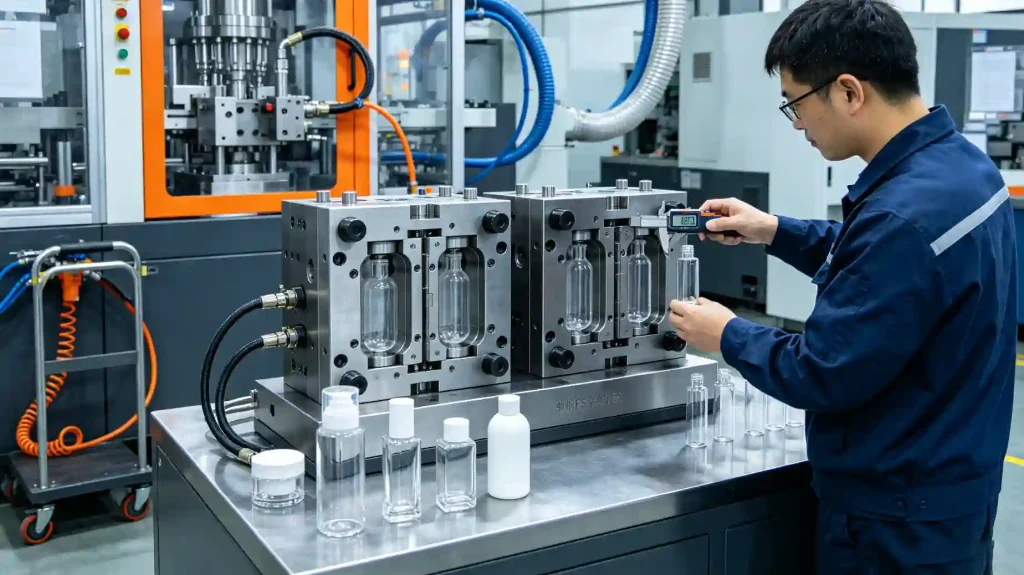
Quick Reference: BPH to Model for Four Common Cosmetic Formats
200ml Round PET Lotion Bottle (50mm body diameter, 150mm height)
| Required BPH | Recommended Model | Machine BPH | Utilization |
|---|---|---|---|
| Under 2,500 | HGA.ES-2C100 | 2,400 | ≤ 100% |
| 2,500–4,000 | HGA.ES-4C76 | 4,800 | 52–83% |
| Above 5,000 | HGA.ES-6C76 | 7,200 | 70% at 5,000 |
1,000ml Standard PET Pump Bottle (88mm body diameter, 250mm height)
| Required BPH | Recommended Model | Machine BPH | Notes |
|---|---|---|---|
| Under 2,000 | HGA.ES-2C114.3 | 2,000 | 100% utilization — specify ES-3C114 for buffer |
| 2,000–3,500 | HGA.ES-3C114 | 2,400 | Ceiling at 2,400 bph limits buffer |
| 3,500–4,500 | HGA.ES-4C114.3 | 4,000 | Good buffer at 3,500 bph |
| Above 4,500 | HGA.ES-6C114 | 5,400 | High-volume personal care lines |
100ml Faceted PETG Perfume Bottle (40mm × 25mm cross-section, 130mm height)
| Required BPH | Recommended Model | Cavities | Notes |
|---|---|---|---|
| Under 700 | HGA.FS-1CG130 | 1 | FS required — aspect ratio 1.6:1 exceeds ES threshold |
| 700–1,000 | HGA.FS-2CG220 | 2 | Only FS-2CG handles this geometry at higher output |
| Above 1,000 | 2× HGA.FS-1CG130 | 1 + 1 | Two machines — or evaluate container design change for ES compatibility |
Utilities Checklist: What the Cavity Count Decision Also Determines
Cavity count determines not only which machine you order but also what supporting utilities the production line requires. Specify these before committing to a model — high-pressure compressed air is the most frequently underspecified utility in new cosmetic bottle line installations.
| Utility | 2-Cavity ES | 4-Cavity ES | 6-Cavity ES |
|---|---|---|---|
| High-pressure blow air | 1,000–1,600 ltr/min at 26–35 kg/cm² | 3,900–6,500 ltr/min at 35 kg/cm² | 5,800–9,500 ltr/min at 35 kg/cm² |
| Cooling water | 30–50 ltr/min 5–6 kg/cm², 8–12 °C | 30–60 ltr/min 5–6 kg/cm², 8–12 °C | 40 ltr/min 5–6 kg/cm², 8–12 °C |
| Electrical load (operating) | 15–35 kW | 18–32 kW | 26–32 kW |
Domande frequenti
▶ If my volume will double in 18 months, should I buy the higher-cavity machine now?
▶ Does the model number encode the cavity count and container size?
▶ Can one machine run a 500ml and a 200ml bottle in the same production week?
▶ What is the minimum production run length that makes a mold changeover economically viable?
Ready to size the right machine for your line?
Submit your container volume, body diameter, neck finish, and weekly production target — receive a specific model recommendation from the 23-model HGA cosmetic range within 24 hours.