
Edible oil jugs with integrated handles present a manufacturing question that precedes machine selection: which process route — extrusion blow molding (EBM) or injection stretch blow molding (ISBM) — produces the better container, and at what trade-offs? The answer depends on the volume of the jug, the optical and structural requirements of the brand, and the output rate the production line must sustain.
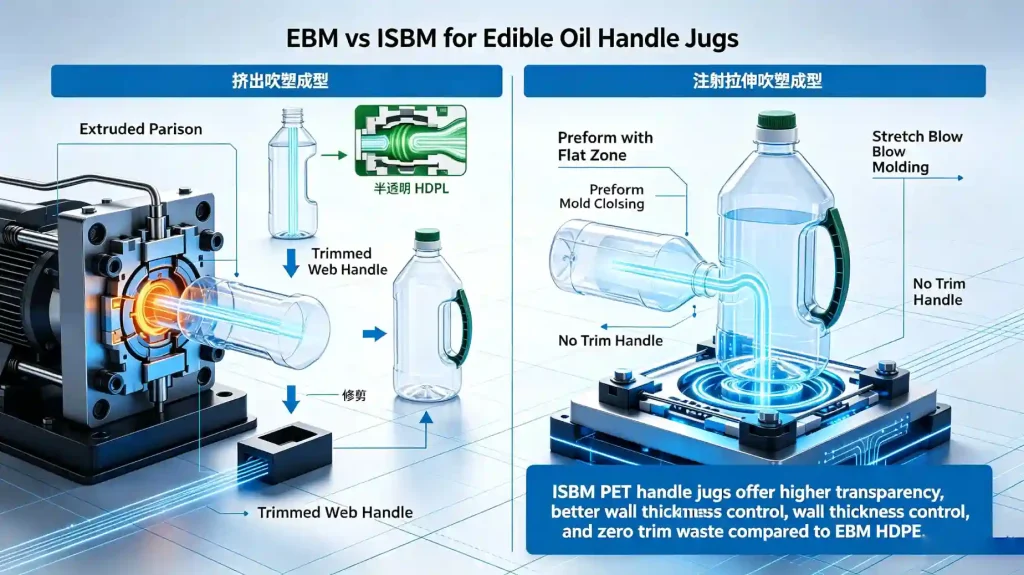
How EBM and ISBM form handles differently
Fundamental mechanism comparison from a tooling and stretch standpoint
Extrusion blow molding (EBM) forms the container and handle in a single extrusion-and-blow cycle. Molten HDPE is extruded as a hollow parison; the mold closes around it and pinches the handle area into a solid web, which is trimmed to form the grip. ISBM on the HGA handle series forms the handle differently — the preform has a flat zone on the handle side, which inflates less than the opposing panel during blowing, forming a stiffer wall that becomes the handle root. No web, no trimming.
The transparency advantage in retail
Consumer research in edible oil retail consistently shows transparent PET containers command a 3–8% price premium over opaque HDPE in self-service environments, because shoppers use visible oil color and clarity as quality proxies. EBM HDPE cannot deliver this.
Handle root structural comparison: thinner wall, higher strength
Why ISBM PET handle strength exceeds EBM HDPE despite thinner walls
A 5L edible oil jug filled with oil (~4.6 kg at 0.92 g/ml) exerts approximately 45–55N at the handle root during one-handed pouring. An ISBM PET handle root at 2.0mm wall and 80 MPa tensile strength achieves a design safety factor of approximately 6:1 — well above the 3:1 minimum for consumer packaging. The EBM HDPE pinch web at 3.5mm wall and 24 MPa achieves approximately 2.5–5:1 depending on the thinnest point in the pinch zone.
ESCR consideration for edible oil
Vegetable oils containing free fatty acids above 0.5% can initiate stress cracking at the ISBM PET handle root if the gate zone was under-conditioned. Specify PET resin IV ≥ 0.78 dL/g and set gate zone IR lamp output 18–22% above the body zone to ensure adequate orientation at this critical location.

HGA handle series: model specifications
Model selection by container volume and output requirement
When to choose EBM and when to choose ISBM
Decision framework by container format and market requirement
- ·Container exceeds 5L — ISBM handle architecture has volume limits
- ·Formulation contains aggressive surfactants or solvents
- ·Opacity is acceptable or preferred by the brand
- ·Existing EBM equipment is available and capital is constrained
- ·Retail transparency is a brand requirement
- ·Label panel flatness ≤ ±0.2mm required
- ·Container weight reduction is a target (PET 25–35% lighter)
- ·Output rate above 1,500 bph for 1–2L formats
Frequently asked questions
Evaluating EBM vs ISBM for your edible oil jug line?
Share your container volume, transparency requirement, output target, and existing equipment — receive a process route recommendation with machine specification.