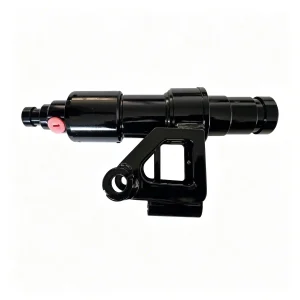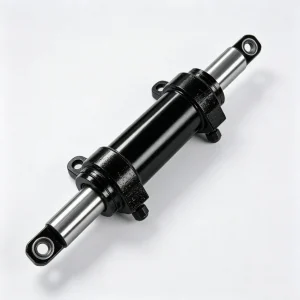
Сипаттама

Heavy-Duty Steering System
Forklift Steering Cylinder — 70 mm Bore, 766 mm Mounting for Large-Class Counterbalance Forklifts
Rod: 40 mm
Stroke: 178 mm
Mounting: 766 mm
Бұл forklift steering cylinder with a 70 mm bore and a 766 mm center-to-center mounting distance is engineered for 4–7 ton class large counterbalance forklifts and heavy-duty reach stackers where steering loads exceed the capacity of standard 65 mm bore units. The larger bore area delivers greater hydraulic force at identical system pressure, ensuring positive, predictable directional control even when the rear axle carries elevated static and dynamic loads from heavy lifted payloads.
Technical Specifications
| Cylinder Type | Double-Acting Steering Cylinder (Heavy Class) |
| Bore Diameter | 70 mm |
| Rod Diameter | 40 mm |
| Stroke Length | 178 mm |
| Installation Distance (C-C) | 766 mm |
| Target Machine Class | 4–7 Ton Counterbalance / Reach Stacker |
Why 70 mm Bore and 766 mm Mounting Distance Define Heavy-Class Forklift Steering Cylinder Selection
Stepping up from a 65 mm to a 70 mm bore increases the effective piston area by approximately 16%. At 160 bar system pressure, this translates from about 53 kN to 62 kN of hydraulic force — an increase of roughly 9 kN. While this may seem incremental on paper, it is operationally significant in the real-world context of large forklifts: a 5-ton machine with a lifted load of 4 tons positioned at a significant mast tilt generates rear axle dynamic loads that can exceed 1.8 tons during cornering maneuvers. Under these conditions, the additional steering force reserve prevents the steering valve from reaching its pressure relief setting during sharp turns — a condition that causes temporary steering lock-up and is a serious operator safety concern.
The 766 mm C-C mounting distance is equally critical and clearly differentiates this cylinder from the 3-ton class LS-HCZD30N-03 unit (676 mm). The longer mounting distance reflects the wider rear axle track on 4–7 ton machines — a dimensional consequence of the larger tire section width and axle beam cross-section required for higher load ratings. Using a shorter cylinder on a wider axle reduces the effective moment arm, requiring the cylinder to generate proportionally more force to achieve the same steering angle — exactly the wrong trade-off when the machine is already at the upper end of its steering load envelope.
The 178 mm stroke on this unit is slightly shorter than the LS-HCZD30N-03’s 187.2 mm, which reflects a different rear axle pivot arm geometry common in larger machines. The result is a maximum steering angle of approximately 50–58 degrees — still sufficient for narrow aisle operation in properly designed heavy-duty warehouse layouts while avoiding the extreme articulation angles that would impose excessive wear on rear tires and axle pivot bearings.
Structural Design and Material Specification for Heavy-Duty Forklift Hydraulic Steering Actuators
The barrel of this steering cylinder is manufactured from E355 seamless hydraulic tubing (DIN 2391 equivalent), which provides a minimum yield strength of 355 MPa — suitable for operating pressures up to 250 bar with standard safety factors applied. The tube is precision cold-drawn to minimize wall thickness variation, then internally honed to achieve the bore tolerance and surface finish required for consistent seal performance across the full stroke. Post-honing, the bore is subject to dimensional verification using air gauging to confirm compliance with H8 ISO tolerance limits.
The 40 mm rod is manufactured from C45E induction-hardened and tempered steel, achieving surface hardness of 55–62 HRC to a depth of 0.8–1.2 mm. This hardened layer provides the wear resistance needed for the rod wiper and seal interaction, while the tough core material resists fracture under impact loads that occur when the forklift’s rear wheels encounter abrupt obstacles. The rod is precision-ground and hard-chrome plated to 20–25 μm thickness, then inspected for chrome adhesion and surface defect using magnetic particle inspection sampling.
End connections on both the cap end and the rod end use clevis-type fittings with through-bored pin holes machined to H7 tolerance — the precision fit ensures minimal radial play at the pin joints, which would otherwise manifest as noticeable steering “slop” felt by the operator and as accelerated wear on the pin and bore. Grease nipples are provided at both clevis pin locations for regular lubrication maintenance.
Primary Applications
- 4–5 ton IC counterbalance forklifts (diesel / LPG) in heavy manufacturing
- 6–7 ton counterbalance forklifts in steel service centers and paper mills
- Reach stackers for container yard operations at seaports
- Heavy-duty pallet transporters for aerospace component handling
- Side-loader forklifts with hydraulic steering axles
- Underground mining vehicles with articulated hydraulic steering
Procurement, Cross-Reference, and Custom Configuration Options for 70 mm Bore Forklift Steering Cylinders
Facilities managing fleets of large forklifts across industries such as automotive manufacturing, steel service, and bulk port operations have specific procurement needs that differ from lighter-duty warehouse operations. Scheduled preventive replacement of steering cylinders at predetermined service intervals — rather than reactive replacement after failure — is a standard practice in operations where a grounded forklift creates production line interruptions worth tens of thousands of dollars per hour. Our team supports scheduled MRO programs with blanket purchase orders, guaranteed stock allocation, and documented dimensional and material certification.
For OEM integrators developing new machine designs or next-generation heavy lift platforms, we offer engineering collaboration on cylinder specification, FEA-supported mounting bracket design review, and prototype cylinder supply for validation programs. Custom port locations, alternative clevis pin sizes, extended chrome rod lengths for space-constrained mounting configurations, and modified end fitting styles (trunnion, flange, or spherical eye) are all available subject to engineering review and minimum order confirmation.
Specify This Steering Cylinder for Your Heavy-Class Forklift Fleet
Reach out for batch quotations, engineering drawing packets, material certification documentation, and custom configuration options for OEM integration programs.