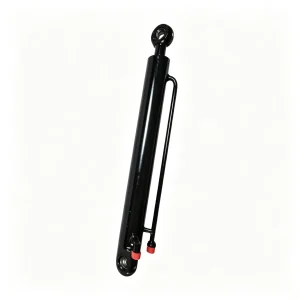
Descrizione
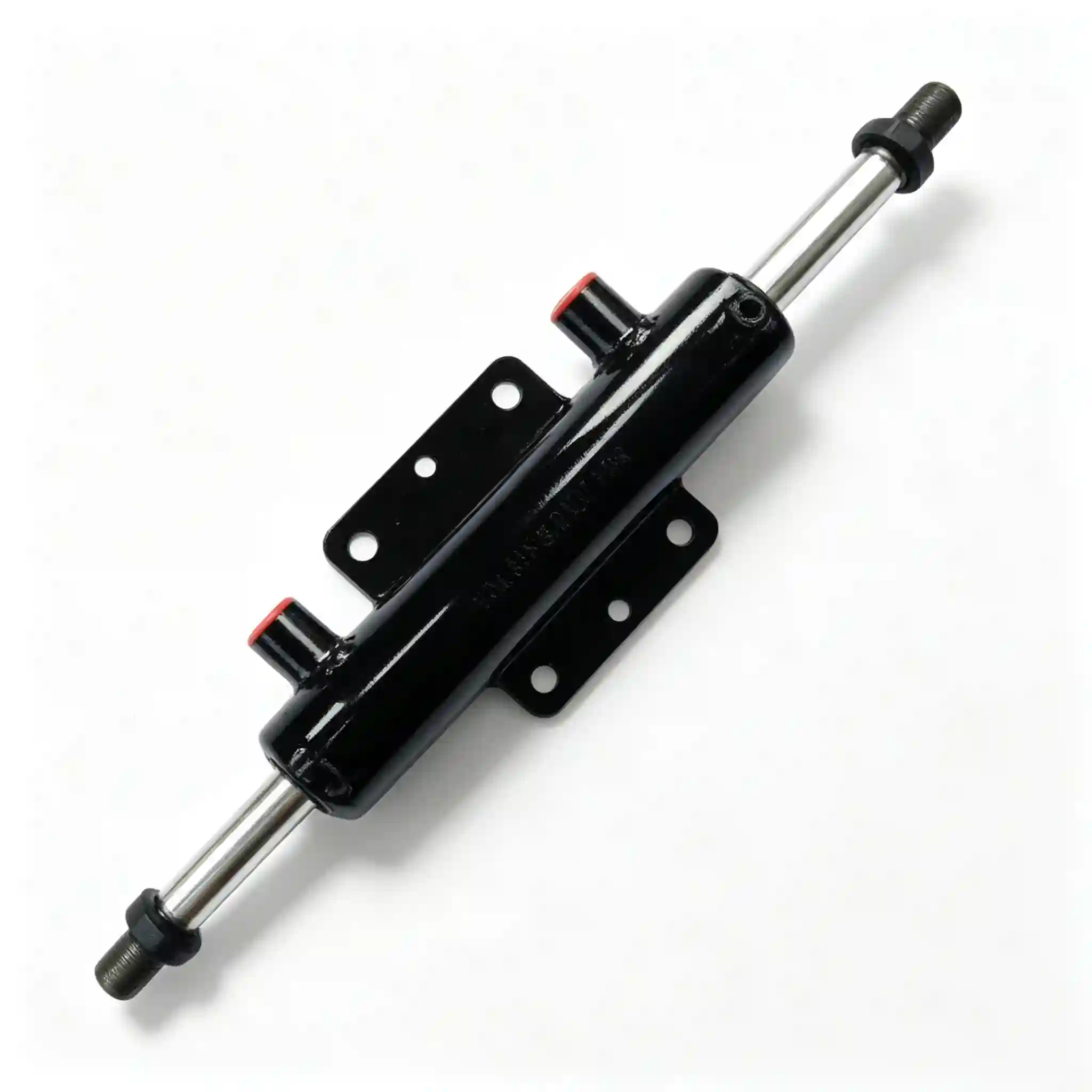
ZY254.31F.019A Tractor Power Steering Cylinder — 40 mm Bore × 140 mm Stroke Direct-Replacement Ram
| OEM Part Number | ZY254.31F.019A |
| Bore Diameter | 40 mm |
| Rod Diameter | 25 mm |
| Stroke | 140 mm |
| Mounting Distance (C-C) | 480 mm |
| Cylinder Type | Double-Acting, Tie-Rod |
| Applicazione | Agricultural Tractor Front Axle Steering |
| Seal Material | Polyurethane (PU) + NBR O-Ring |
Request a Quote or Sample
OEM orders · Custom bore/stroke available · Lead time 7–15 days FOB
Engineering Overview: 40 mm Bore Hydraulic Steering Cylinder for Compact Tractor Front Axle Integration
The ZY254.31F.019A Tractor Power Steering Cylinder is a precision-machined, double-acting hydraulic ram engineered as a factory-specification replacement for the ZY254 series compact agricultural tractors. With a 40 mm bore, 25 mm chrome-plated piston rod, and a net stroke of 140 mm, this cylinder occupies a distinct dimensional niche within the sub-50 hp tractor steering segment—one that demands tight packaging, reliable return-to-centre behaviour, and consistent steering effort across variable soil-load conditions.
The ZY254.31F.019A designation follows Chinese GB/T standard hydraulic component numbering. The “ZY254” prefix identifies the tractor model family, “31F” denotes the front axle steering subassembly group, and “019A” is the sequential cylinder revision code. This traceability matters for OEM procurement officers and fleet maintenance engineers who must cross-reference part numbers against bill-of-materials records or import customs declarations. Misidentified steering cylinders are one of the most common causes of costly front axle rebuilds—incorrect mounting-distance or bore size forces hydraulic pressure to compensate through seal deformation, accelerating wear far beyond design service life.
The 480 mm centre-to-centre mounting distance is calibrated to the ZY254 front axle pivot geometry. At full lock, the cylinder rod extends or retracts through its full 140 mm travel, sweeping the front wheel through a design-specified turn arc. Any deviation in mounting distance—even ±5 mm beyond tolerance—alters the Ackermann geometry, producing unequal inner/outer wheel slip angles under cornering. For row-crop field operations where precision steering is essential to protect established crop rows, dimensional accuracy in the replacement cylinder is not optional; it is a fundamental operating requirement.
This cylinder suits compact two-wheel-drive tractors in the 25–35 hp range, specifically those built around the Ningbo-pattern front axle standard. It is also used as an interchange part for equivalent-class machines in Southeast Asian markets and emerging agricultural fleets in South Asia, where the ZY254 chassis is licence-produced or reverse-engineered to the same front axle specification.

Structural Analysis: Bore-to-Rod Ratios, Operating Pressure, and Chrome Plating Specification for Tractor Hydraulic Ram Durability
The bore-to-rod area ratio of the ZY254.31F.019A is approximately 2.56:1 (bore area 1,257 mm², rod area 491 mm²). This ratio governs the differential force between the extend and retract strokes. At a typical tractor steering circuit operating pressure of 10–14 MPa (1,450–2,030 psi), the extension force at 12 MPa reaches approximately 15.1 kN, while the retract force is approximately 9.2 kN. This asymmetry is by design: agricultural front axles encounter heavier resistance when the wheel is steered into a turn loaded by weight transfer, and the larger extension force ensures the operator does not feel increased effort at the steering wheel under full-load conditions.
The cylinder barrel is manufactured from 20# seamless precision steel tube (equivalent to AISI 1020 seamless grade), honed to an internal surface finish of Ra ≤ 0.4 µm. This honing standard is critical: too rough a bore surface (Ra > 0.8 µm) causes piston seal lip wear within the first 500 operating hours; too smooth (Ra < 0.2 µm) removes the micro-valleys that retain hydraulic oil film, leading to dry-running contact under cold-start conditions when oil viscosity is temporarily elevated.
The 25 mm piston rod is turned from 45# carbon steel bar, heat-treated to a surface hardness of 55–60 HRC via induction hardening, and then hard chrome-plated to a minimum coating thickness of 20–25 µm. This chrome layer serves three concurrent engineering functions: it provides the bearing surface for the rod seal, it resists corrosion from field spray and high-humidity storage, and it reduces rod-to-seal friction by providing a surface that polishes to Ra ≤ 0.2 µm after run-in. Post-plating, the rod undergoes dimensional grinding to h6 tolerance (±8 µm on a 25 mm nominal), ensuring the rod wiper seal achieves its designed interference fit without excessive drag or premature lip distortion.
The seal kit consists of four elements: a polyurethane (PU) piston seal, an NBR O-ring piston secondary seal, a PU rod U-seal, and a polyurethane wiper/dust seal at the gland. PU is selected for the primary seals due to its superior pressure lip performance under dynamic cycling: PU maintains seal geometry at pressures up to 20 MPa and temperatures from -30°C to +80°C, whereas traditional NBR seals begin to extrude into clearance gaps above 16 MPa on 40 mm bore cylinders. The NBR O-ring serves a static backup function between the piston body and barrel wall, preventing internal leakage should the PU primary seal experience a temporary pressure spike during aggressive counter-steering manoeuvres.
Front Axle Fitment: OEM Cross-Reference Dimensions and Pin Hole Clearances for Ningbo-Standard Tractor Steering Cylinder Replacement
The ZY254.31F.019A mounts to the tractor front axle via clevis-and-pin connections at both the barrel end and rod end. The pin holes are bored to 22 mm nominal diameter with H7 tolerance (0 / +0.021 mm), matching the standard Ningbo-axle steering arm pin specification of 22f7 (−0.020 / −0.041 mm). When correctly matched, the assembly clearance runs between 0.020 mm and 0.062 mm—sufficient for free oscillation of the cylinder during bump-induced front axle articulation, yet tight enough to prevent perceptible play at the steering wheel.
For OEM cross-referencing, the ZY254.31F.019A is mechanically interchangeable with steering cylinders used on several Chinese compact tractor models that share the same front axle beam dimensions. Verified interchange candidates include agricultural machines produced around Shandong, Jiangsu, and Fujian province tractor plants under private-label branding. The critical verification dimensions are: bore 40 mm (±0.1 mm), rod 25 mm (±0.05 mm), stroke 140 mm (±1 mm), and mounting C-C distance 480 mm (±2 mm). Any import purchasing agent or distributor should request a dimensional certification sheet confirming these four parameters before approving a bulk shipment.
The cylinder’s overall collapsed length (retracted OAL) calculates to approximately 480 mm + 20 mm (clevis depth × 2) = ~520 mm overall. This figure must be verified against the axle beam clearance envelope on the target machine, particularly for tractors fitted with aftermarket front weights or narrow front-axle conversion kits. On standard ZY254-specification machines, the axle beam provides 545 mm of clearance at the cylinder mounting bracket, giving a 25 mm safety margin against contact at full retraction.
Procurement engineers sourcing this cylinder for fleet maintenance operations should note that the ZY254.31F.019A is classified as an A-revision part. The original ZY254.31F.019 (without the A suffix) used an older 18 mm rod diameter that proved insufficiently rigid for sustained heavy-land ploughing applications, producing detectable rod deflection under lateral load that caused uneven seal wear at the gland. The A-revision upgrade to 25 mm rod diameter increased rod section modulus by a factor of approximately 2.4, eliminating this failure mode entirely. Ensure procurement records specify the “A” revision explicitly to avoid receiving legacy-spec cylinders from secondary suppliers.
Installation, Hydraulic Bleeding, and Seal Maintenance Intervals for the 40 mm Bore Power Steering Cylinder Replacement
Before mounting, inspect both clevis bores for ovality. A worn clevis bore that measures beyond 22.15 mm (0.15 mm over nominal) will allow the cylinder to rock on its pin under steering loads, generating micro-impact fatigue at the pin hole shoulder that propagates into barrel-end cracking over 2,000–3,000 operating hours. Replace or rebore oversized clevis brackets before fitting the new cylinder.
Install the cylinder with the rod-end pointing toward the steering arm and the barrel-end fixed to the axle beam bracket. Torque the clevis retention bolts to 35–40 N·m using a calibrated torque wrench; do not use impact drivers, as the shock loading can distort the clevis bore. Fit new split pins or lock washers on all clevis pins—reuse of deformed split pins is a documented failure mode that allows pin ejection under sustained vibration on rough terrain.
Hydraulic connection uses two M14×1.5 or M16×1.5 port fittings (confirm against the tractor’s existing port specification). Prior to final connection, flush the hydraulic hose lines with clean hydraulic oil to remove any metal particles or scale from the lines—contamination is the primary cause of premature piston seal failure in replacement cylinders. Fill the tractor hydraulic reservoir to the maximum mark before bleeding.
Bleeding procedure: With the engine running at low idle, turn the steering wheel slowly from lock to lock five complete cycles. Check for any spongy or hesitant feel, which indicates residual air in the circuit. Repeat the lock-to-lock sequence until the steering response is firm and consistent. Check the hydraulic reservoir level after bleeding and top up if required. Inspect all port connections for seepage; re-torque if necessary to 30–35 N·m for M14 fittings.
Seal replacement intervals depend directly on operating environment. In clean-field applications with regular hydraulic oil changes (500-hour intervals using ISO VG 46 or equivalent), the PU seal kit typically achieves 2,000–3,000 hours before leakage-onset. In heavy-sand or high-dust environments, the wiper seal may require inspection at 1,000 hours, as fine abrasive particles embedded in the wiper lip create scoring channels on the chrome rod surface. Replace the complete seal kit—not individual seals—whenever rod leakage is observed, as differential wear on interacting seal elements means partial seal replacement rarely restores full sealing performance.
Factory Quality Assurance, Pressure Testing, and B2B Bulk Procurement Options for the ZY254.31F.019A Hydraulic Steering Cylinder
Every ZY254.31F.019A unit undergoes a two-stage factory pressure test before dispatch. Stage one is a static proof test at 1.5× the rated working pressure (typically 21 MPa for a 14 MPa rated circuit), held for 3 minutes at full extension and 3 minutes at full retraction. Stage two is a dynamic leakage test: the cylinder cycles through its full stroke 10 times at rated pressure, and post-cycle, any external leakage beyond 0 drops/minute results in unit rejection and full teardown inspection. Only units passing both stages receive the factory QC certification stamp that appears on the outer packaging label.
Chrome rod corrosion resistance is validated by ASTM B117 salt spray testing. A representative sample of chrome-plated rods from each production batch is tested at 5% NaCl solution concentration, 35°C chamber temperature, for a minimum of 240 hours. Acceptable criteria: zero red rust, and no blistering or delamination of the chrome coating. This test protocol aligns with requirements seen in EU-market tractor OEM supply agreements and is increasingly specified by Australian and UK agricultural distributor procurement standards.
For B2B distributors, fleet procurement agencies, and tractor OEM component buyers, the ZY254.31F.019A is available in standard pallet quantities of 50 units per order, with MOQ set at 10 units for initial qualification orders. Lead time for standard-specification stock is 7–12 working days FOB Ningbo or FOB Shanghai. Custom configurations—alternative port thread standards (BSP, NPT, JIC), modified clevis dimensions for non-standard axle brackets, or specific paint/coating requirements—can be accommodated with a production lead time of 20–28 days and a MOQ of 30 units.
OEM white-label supply is available, including custom part number engraving on the barrel end cap, branded packaging design, and technical documentation supplied in English, Spanish, Portuguese, or French for international distributor markets. Each export shipment is accompanied by a material test certificate (MTC) for the barrel tube and rod bar stock, a dimensional inspection report for bore, rod, and stroke, and a batch-level pressure test certificate.
Request a Quote: ZY254.31F.019A Tractor Power Steering Cylinder
Send your quantity requirement, target market, and any custom fitment specifications. Our technical sales team responds within 1 business day with FOB pricing, lead time, and a dimensional confirmation drawing.
MOQ: 10 units | Lead time: 7–12 days FOB | OEM custom options available