
Pharmaceutical container design decisions are validated, not just engineered — and the intended number of fill cycles is one of the variables that feeds the validation. A container designed and validated for single use that is refilled in practice represents an uncontrolled deviation from the validated process; a container designed for multiple fills but produced with insufficient surface finish quality, wall thickness margin, or neck finish durability fails before the validated cycle count is reached. The machine specification, mold design, and material selection must reflect the intended use pattern at the outset, because revising the container specification after regulatory approval of the drug product requires a post-approval change submission that takes 12–36 months. This article addresses how single-use and refillable pharmaceutical container specifications differ structurally, what machine parameters drive the refillable container’s durability, and where cleaning validation intersects with the blow molding machine documentation.
Structural specification differences: single-use vs refillable
Wall thickness, neck finish durability, surface finish, and ESCR requirements — quantified by use category
A single-use pharmaceutical container must maintain its structural and dimensional specification from the moment of blow molding through the filling operation, storage at distribution temperature and humidity conditions, and one use event by the patient or healthcare provider. The shelf life is typically 12–36 months from fill date at ambient storage conditions (typically defined as ≤25°C / 60% RH in ICH Q1A stability testing). Beyond this envelope, the container’s mechanical properties are irrelevant — it is discarded. This means the wall thickness floor is set by the structural requirements of distribution (top-load for stacking, drop resistance for distribution handling) and the time-zero fill integrity (torque retention at the neck finish). For a typical 100ml oral liquid PET medicine bottle, these requirements converge on a body wall thickness specification of 0.25–0.35mm and a base wall specification of ≥1.8mm — the minimum adequate wall to pass a 1.0m drop test at full fill density over the product’s shelf life, accounting for PET creep at ambient temperature over 36 months.
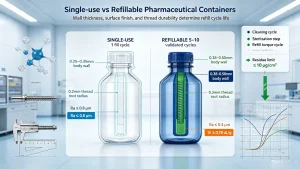
A refillable pharmaceutical container — used in hospital pharmacy dispensing, institutional healthcare, or consumer multi-dose formats — must survive this same structural envelope repeated for each validated fill cycle. Each cycle introduces: a cleaning step (involving mechanical stress from water jet or brush agitation, thermal stress from hot water at 60–80°C, and chemical stress from the validated cleaning agent); potentially a sterilization step (hydrogen peroxide vapor, UV-C irradiation, or steam at ≤80°C for heat-tolerant formats); a refill operation (which introduces a fresh fill weight load to the base and a new application of closure torque to the neck finish thread); and a re-use event. Across 5–10 validated fill cycles, the cumulative mechanical stress on the container is 5–10× the single-use stress envelope — and the cumulative chemical stress from cleaning agents is a new exposure that does not occur in single-use containers.
The structural consequence is that refillable pharmaceutical containers require 25–40% heavier walls than single-use equivalents of the same volume and geometry, and they require a higher-IV PET resin to resist the chemical stress of repeated cleaning agent exposure. The body wall for a refillable 500ml oral liquid dispensing bottle is typically 0.38–0.50mm (vs 0.25–0.35mm for single-use), and the resin IV specification is ≥0.78 dL/g (vs ≥0.72 dL/g for single-use). The higher wall thickness directly affects the blow molding machine settings: the heavier preform required for refillable container production needs a longer conditioning dwell time (to heat through the thicker preform wall to the core), and the blow cycle requires a longer cooling dwell time (to extract more thermal energy through the thicker blown wall before mold opening).
Machine parameters that determine refillable container durability
Inner surface roughness, thread profile accuracy, and residual stress management — specific HGA.ES settings
Inner surface roughness (Ra) of the blown pharmaceutical container is controlled by two factors: the surface finish of the blow mold core (the inner mandrel surface that the preform inflates against during the blow cycle) and the blow pressure. During the blow cycle, the inflating PET presses against the mold cavity outer surface; the inner surface of the bottle body — which contacts the pharmaceutical product — forms against the blow air itself, not against a physical mold surface. This means the inner surface finish is determined by the preform inner surface quality (which reflects the injection mold core polish), not by the blow mold core. The preform injection mold core for refillable pharmaceutical container production is polished to Ra ≤ 0.1 µm (mirror-grade, typically SPI A1 or equivalent), and the result in the blown container is an inner surface Ra of 0.2–0.4 µm — the slight roughening from the blow stretch being the only deviation from the injection mold core finish.
For single-use pharmaceutical containers, the injection mold core is polished to Ra ≤ 0.2 µm (SPI A2), which produces blown container inner surface Ra values of 0.4–0.8 µm. The additional roughness is acceptable for single-use applications but creates cleaning validation challenges for refillable containers: pharmaceutical cleaning validation protocols typically require that the inner surface roughness is demonstrated to be cleanable to a defined residue limit (typically ≤10 µg/cm² of total organic carbon residue after the validated cleaning cycle), and a rougher inner surface requires a more aggressive cleaning protocol (higher temperature, longer contact time, or higher cleaning agent concentration) to achieve the same residue level. Specifying the injection mold core at SPI A1 (Ra ≤ 0.1 µm) for refillable containers eliminates this cleaning validation complexity by producing a container inner surface that is cleanable to residue specification under a gentler cleaning protocol — which also reduces the chemical exposure to the container per cleaning cycle, extending the effective service life.
Residual stress at the neck finish thread root is the primary initiation site for neck finish cracking on refillable pharmaceutical containers subjected to repeated closure application and removal torque. The residual stress arises from two sources: non-uniform cooling of the neck finish zone in the injection mold (which freezes the neck in an asymmetric stress state before the material has fully relaxed), and ejection-related stress (if the container is ejected before the neck finish has cooled below Tg, the dimensional change during cooling after ejection introduces additional residual stress into the thread root). Both sources are controlled by the injection mold cooling dwell time at the neck insert. For refillable pharmaceutical containers, the neck insert cooling dwell should be extended by 20–30% relative to the single-use container of the same geometry — this additional dwell time allows more complete thermal equilibration of the neck zone before ejection, reducing both asymmetric cooling residual stress and ejection-related stress. The HGA.ES PLC allows independent cooling dwell time settings for the injection station and the blow station — the injection cooling dwell can be extended without affecting the blow cycle time, maintaining production output while improving neck finish residual stress.
Cleaning validation documentation and the machine manufacturer’s contribution
What the drug product dossier requires, what the blow molding machine supplier provides, and what the user site generates
Cleaning validation for refillable pharmaceutical containers is documented in CTD Module 3.2.P.7 (Container Closure System) as part of the drug product regulatory dossier. The cleaning validation demonstrates that the container, after use and cleaning according to the validated cleaning procedure, contains residue levels of the previous drug product, cleaning agent, and biological material below the defined acceptance criteria. These criteria are typically set at ≤10 µg/cm² total organic carbon (TOC) by rinse analysis, ≤1 µg/ml of previous active pharmaceutical ingredient by specific analytical method, and ≤1 CFU/25 cm² by environmental monitoring (for sterile filling operations).
The blow molding machine manufacturer’s contribution to the cleaning validation documentation package is specific and bounded — it covers the manufacturing process for the container, not the cleaning process itself. Ever-Power provides: (1) a material specification certificate confirming the container’s inner surface composition (PET resin grade, IV range, FDA/Ph. Eur. approval status, additive content including antioxidants, and absence of non-approved processing aids); (2) an inner surface Ra measurement report confirming Ra ≤ 0.4 µm at 5 axial positions for the specific container design and mold tooling, generated from the production first-article qualification batch; (3) a process parameter certificate stating the injection barrel temperature range, holding pressure and time, conditioning temperature range, and blow pressure used to produce the container — confirming that no parameters were used that would introduce non-standard extractables; (4) an NSF H1 lubricant declaration confirming that all machine contact-zone lubrication uses NSF H1 registered lubricants, with registration numbers, and that no non-H1 lubricants are used in any zone where lubricant migration to the container interior is possible. These four documents form the machine manufacturer’s contribution to the container’s cleaning validation regulatory package. The extractables study, the cleaning agent compatibility testing, the actual cleaning validation protocol execution, and the analysis and review of results are performed by the user site or a contracted CRO.
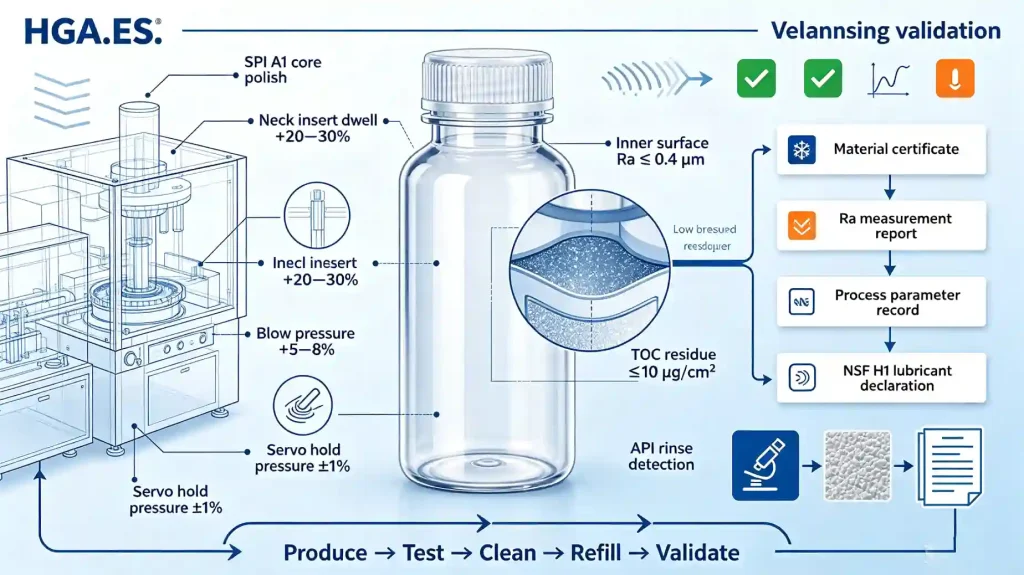
Refillable Container Production & Cleaning Validation Workflow
HGA.ES medicine bottle series: model selection for pharmaceutical production
Production volume and container format by model — single-use and refillable pharmaceutical applications
A hospital pharmacy dispensing system using 500ml refillable PET bottles with 5 validated refill cycles per bottle requires only 20% of the annual container production needed for an equivalent single-use system serving the same dispensed volume. This cycle multiplier directly affects the machine model selection — a refillable container operation can meet the same product throughput with a lower-output machine (fewer cavities or slower cycle rate) than a single-use operation. However, the quality demands on the lower-output machine are higher (inner surface Ra, neck finish durability, residual stress control), so the capital cost difference between a refillable-configured 2-cavity machine and a single-use 4-cavity machine may be smaller than the cavity count suggests.
Frequently asked questions
Specifying a refillable pharmaceutical container line?
Share your drug product type, validated refill cycle target, container volume, and cleaning agent — receive an HGA.ES model recommendation with mold specification guidance for refillable pharmaceutical containers.