
Every food container manufacturer choosing blow molding equipment faces the same process choice: one-step injection stretch blow molding (ISBM), where the preform is injected and blown in the same machine and cycle; or two-step stretch blow molding (SBM), where commercially sourced preforms are reheated and blown on a separate machine. The decision determines capital outlay, per-unit production cost, quality control architecture, and operational flexibility for the next 10–15 years of the machine’s service life. Getting it wrong in either direction has quantifiable consequences.
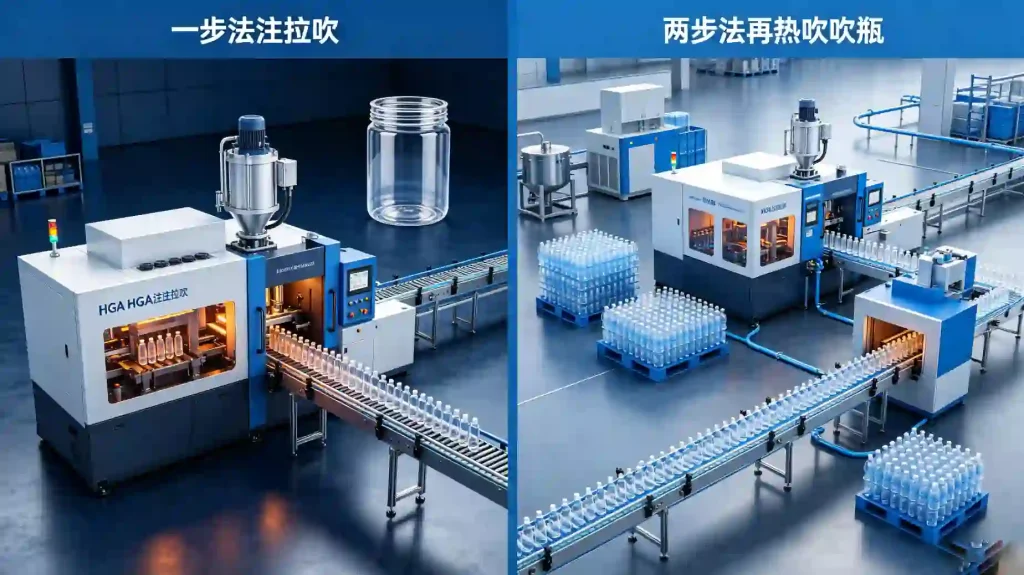
Process Architecture: How One-Step and Two-Step Differ
| Process Stage | One-Step ISBM (HGA Series) | Two-Step SBM (Reheat Blow) |
|---|---|---|
| Preform production | Injected in the same machine as part of the ISBM cycle. Machine controls all preform parameters: wall thickness distribution, neck finish dimensions, IV retention. | Purchased externally from preform suppliers, or produced on a separate injection molding machine. Preform quality is a supply chain dependency. |
| Thermal history | Preform goes from injection melt to conditioning to blow without cooling to ambient. One thermal cycle — minimum degradation, minimum AA generation. | Preform cools to ambient after injection, then is reheated from ambient to blow temperature. Two full thermal cycles — higher cumulative AA generation, higher risk of IV degradation. |
| Equipment footprint | One machine performs all operations. Footprint: 2,525–6,200mm × 1,525–2,150mm depending on model. | Preform injection machine + storage + reheat blow machine. Combined footprint typically 2–3× larger than equivalent ISBM output. |
| Output scalability | Cavity count determines output — 1 to 6 cavities, 600–4,600 bph for food jar formats. Each additional cavity requires mold investment; output scales in discrete steps. | Reheat blow machines can run 6–32 cavities at 10,000–50,000 bph for standard beverage bottles. For food jars, throughput is limited by wide-mouth preform availability and handling complexity. |
| Minimum viable volume | Economically viable at 500,000–5,000,000 units/year per machine depending on jar format. Below ~500,000 units/year, ISBM capital is difficult to recover. | Two-step is viable at lower volumes for standard preform sizes where commercial preform supply is reliable. For wide-mouth food jar formats, commercial preform supply is limited and the two-step economic advantage diminishes. |
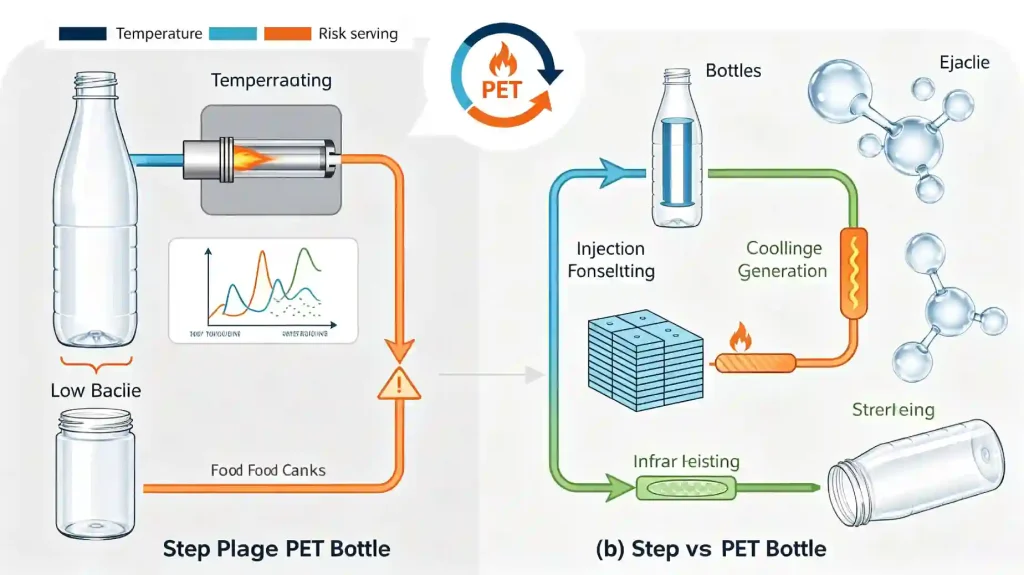
AA Generation Comparison: Why One Thermal Cycle Matters for Food Compliance
Acetaldehyde (AA) generation in PET is cumulative across thermal exposures. Every time PET is heated above its glass transition temperature (Tg ≈ 72–76°C), additional AA is generated from chain-end thermal scission reactions. The amount generated per thermal exposure depends on temperature, duration, and the PET resin’s AA-generating tendency (expressed as the resin supplier’s reported AA generation rate in µg/g·pass).
| Process Stage | One-Step ISBM | Two-Step SBM |
|---|---|---|
| Injection melt (270–275°C) | ✓ Present (unavoidable) | ✓ Present (unavoidable) |
| Preform cooling to ambient | ✗ Not present | ✓ AA migrates to preform surface during storage |
| Preform reheating (IR oven, 95–120°C) | ✗ Not present (one-step conditioning differs) | ✓ Additional AA generation cycle |
| Conditioning station (ISBM) | Minor (surface only, ≤118°C ceiling) | ✗ Not applicable |
| Estimated total AA in finished container | 3–6 µg/g (typical food-grade PET) | 6–12 µg/g (due to second thermal cycle) |
EU 10/2011 context: The EU AA migration limit for PET in contact with water and beverages is 6 µg/kg food. One-step ISBM containers typically land within this limit without resin modification. Two-step SBM containers for the same application often require AA-scavenger-containing PET resins (which add cost) to achieve sub-6 µg/kg migration in wide-mouth food jar formats where the container-to-food contact area-to-volume ratio is higher than in narrow-neck bottles.
Cost-Per-Bottle Analysis: One-Step ISBM vs Two-Step SBM for Food Jars
The following analysis uses a 1,000ml food jar (condiment or honey format) as the reference container, with production at 1,800 bph on a 2-cavity machine running 16 hours/day, 250 days/year = 7.2 million jars/year. All cost figures are indicative; actual values depend on local energy tariffs, resin pricing, and labor rates.
| Cost Category | One-Step ISBM (HGA.ES-2C130) | Two-Step SBM (Preform + Reheat) |
|---|---|---|
| Machine capital (amortized over 10 yr) | Single machine investment | Injection machine + blow machine (2× capital) |
| Resin cost (PET, 28g jar) | Lower — no AA-scavenger resin needed | Higher — AA-scavenger grade for food compliance adds ~$80–120/ton premium |
| Preform supply cost | Zero — preform produced in-machine | Wide-mouth jar preforms: supply limited, typically $0.04–0.07/preform premium vs standard beverage preforms |
| Energy consumption (per 1,000 jars) | ~8–12 kWh (one thermal cycle) | ~14–20 kWh (two thermal cycles + reheat oven) |
| QC scope | One process to monitor and control | Two processes (injection + blow) + incoming preform inspection program |
| SKU flexibility | Full mold change = new jar format; no external preform dependency | New jar format requires new preform tooling + new blow mold; external preform supply for wide-mouth formats is constrained |
Annual Energy Saving — One-Step vs Two-Step (7.2M jars/year reference)
| Metric | ISBM One-Step | Two-Step SBM | Annual Saving |
| Energy per 1,000 jars | 10 kWh | 17 kWh | 7 kWh / 1,000 jars |
| Annual total at 7.2M jars | 72,000 kWh | 122,400 kWh | 50,400 kWh |
| Annual cost saving @ $0.10/kWh | — | $5,040/year | |
Decision Framework: When Each Process Wins
One-Step ISBM is the correct choice when:
| |||||
Two-Step SBM may be preferred when:
|
Veelgestelde vragen
▶ What is the typical payback period for a one-step ISBM food jar machine vs a two-step setup at 2 million jars/year?
▶ Can the HGA ISBM machine accept externally sourced preforms instead of injecting its own?
▶ How does wall thickness control compare between one-step and two-step for food jars?
▶ Is one-step ISBM suitable for organic and natural food products marketed as “minimum processing”?
Evaluating one-step vs two-step for your food jar line?
Share your annual volume, container format, fill product, and target market — receive a process comparison with cost-per-bottle modelling for your specific production parameters.