Beschrijving
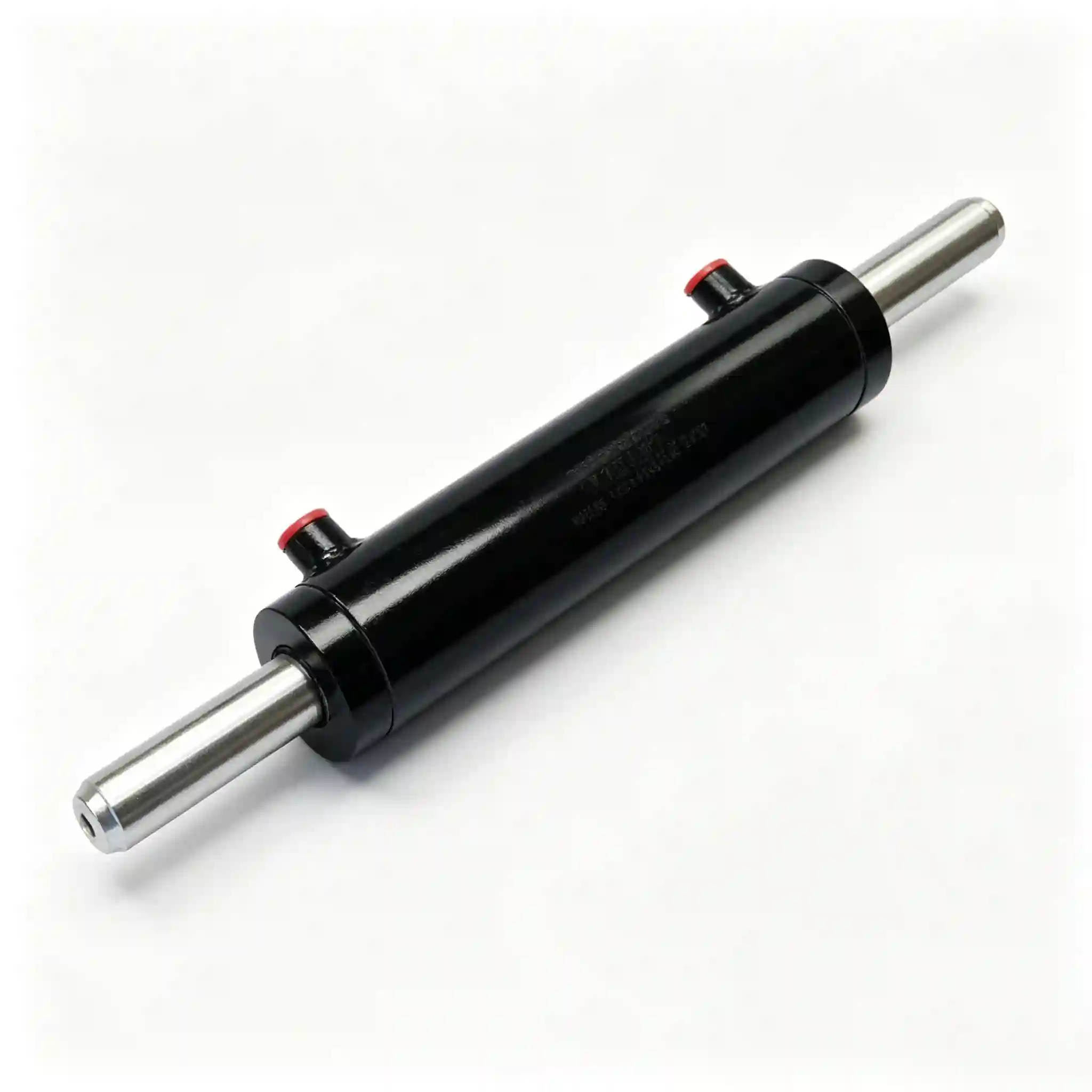
MWTE023-11010084 Hydraulic Power Steering Cylinder for Tractor — 50 mm Bore × 230 mm Stroke Heavy-Duty OEM Steering Ram
| OEM Part Number | MWTE023-11010084 |
| Bore Diameter | 50 mm |
| Rod Diameter | 32 mm |
| Stroke | 230 mm |
| Mounting Distance (C-C) | 574 mm |
| Cylinder Type | Double-Acting, Single Body |
| Sollicitatie | Mid-to-Large Agricultural Tractor Steering |
| Seal Material | PU Primary + NBR Backup O-Ring |
Request Bulk Pricing or OEM Sample
50 mm bore · 230 mm stroke · 574 mm C-C · Ships FOB Ningbo
Engineering Overview: MWTE023-11010084 Long-Stroke 230 mm Tractor Hydraulic Power Steering Cylinder for Wide-Track Mid-Range Axle Applications
The MWTE023-11010084 Hydraulic Power Steering Cylinder for Tractor represents one of the more demanding configurations within the standard 50 mm bore tractor steering cylinder category. Its combination of a 50 mm bore, a reinforced 32 mm piston rod, and a 230 mm stroke—producing a stroke-to-bore ratio of 4.6:1—positions it squarely in the mid-to-large agricultural tractor segment, specifically for front axle geometries that require extended cylinder travel to achieve full lock-to-lock wheel rotation on wider-track chassis. The 574 mm centre-to-centre mounting distance is among the longer C-C dimensions encountered in the 50 mm bore class, indicating that the target axle bracket positions are set relatively far apart to accommodate a wide axle beam width or a long steering arm lever configuration.
The MWTE023 prefix follows the same MWTE-series part numbering convention as the MWTEHX-2101043 reviewed previously: “MWTE” designates the tractor equipment family, “023” is the chassis sub-variant code, and “11010084” is the assembly drawing identifier. This part number appears in the service documentation of mid-range two-wheel-drive tractors in the 50–80 hp class sold across multiple export markets under diverse brand names. Procurement engineers maintaining parts records for mixed-brand tractor fleets should note that the MWTE023 chassis sub-variant code may correspond to a specific wheelbase or front axle width variant within the broader MWTE tractor family, and not all MWTE-series tractors use this cylinder—confirming the stroke and C-C distance against the machine’s actual measurements remains essential before approving a procurement order.
The 32 mm rod diameter is the key structural differentiator for this model. In the 50 mm bore class, rod diameters of 25, 28, and 32 mm are all used across different OEM specifications. The 32 mm rod choice signals that the design authority specified a higher buckling safety margin than a 25 mm or 28 mm rod would provide at 230 mm stroke. At full extension, a 32 mm rod with 230 mm effective length has a Euler buckling load of approximately 180 kN (assuming fixed-pinned end conditions), which exceeds the maximum extension force at rated pressure (23.6 kN at 12 MPa) by a factor of approximately 7.6. This ample margin accounts for dynamic lateral loads encountered during fast steering manoeuvres on rough terrain, where the cylinder rod is subject to brief transient loads beyond the static hydraulic force.
Primary market applications for this cylinder include agricultural tractors used for primary tillage, disc harrowing, and sub-soiling in markets with large field sizes—Australia, Canada, Brazil, and Eastern Europe—where heavier front axle loads and longer field operations at moderate speed produce sustained hydraulic cycling that demands robust seal performance and fatigue-resistant rod metallurgy.

Hydraulic Specifications: 50 mm Bore 32 mm Rod Force Analysis, Fluid Volume Requirements, and Seal Kit Configuration for 230 mm Stroke Power Steering Cylinder
The bore area of the MWTE023-11010084 is 1,963 mm² and the rod area is 804 mm² (based on the 32 mm rod diameter). The bore-to-rod area ratio is 2.44:1, which is notably lower than the 4.0:1 ratio of the split-type Product 3, reflecting the intentional decision to increase rod stiffness at the cost of a higher retract force deficit. At 12 MPa operating pressure, the extension force is 23.6 kN and the retract force is 13.9 kN—a retract-to-extend ratio of 59%. For a tractor steering circuit, this ratio means the operator experiences a slightly higher steering wheel effort when counter-steering against a heavy side load, but the higher rod stiffness more than compensates by eliminating rod deflection-induced seal wear that would otherwise occur at the 230 mm extended position.
The fluid volume displaced by a full extension stroke is 452 cm³ (bore area × stroke = 1,963 mm² × 230 mm). This is a significantly larger volume than the shorter-stroke models and sets a firm requirement on the tractor’s power steering pump capacity. For a standard lock-to-lock steering time of 2.0 seconds, the minimum required pump output is approximately 13.6 L/min at the operating point—a flow demand that exceeds the capacity of small gear pumps (typically 8–10 L/min at mid-idle) and requires either a larger-displacement pump or higher operating RPM to achieve the target steering speed. Tractor technicians fitting this cylinder to machines previously using a shorter-stroke cylinder should verify the existing pump flow rate is adequate for the increased volume demand before installation.
Barrel tube material is 20# seamless precision steel to GB/T 8713, with an internal bore honed to Ra ≤ 0.4 µm. For the 230 mm stroke length, bore honing consistency is particularly important: the honing machine must maintain constant stone pressure and traverse speed across the full 230 mm length without dwelling at the reversal points, which would create micro-ridges at the stroke ends that damage the piston seal lip on every full-travel steering manoeuvre. The factory honing specification for this cylinder requires a 7-step cross-hatch angle of 40–50° and a plateau-finish specification (Rpk ≤ 0.1 µm, Rk ≤ 0.4 µm) to ensure maximum piston seal film retention and minimum seal abrasion.
The 32 mm rod is manufactured from 40Cr alloy steel (AISI 5140 equivalent), the same material specified for the MWTEHX-2101043 rod, confirming that the MWTE design family applies a consistent material upgrade policy for rod diameters above 28 mm. Heat treatment produces a core hardness of 28–32 HRC. Chrome plating is applied to 25–30 µm total thickness, post-ground to h6 tolerance (±9.5 µm on a 32 mm nominal). The longer exposed rod section at full extension—approximately 230 mm of chrome surface exposed to ambient atmosphere—is the primary corrosion risk zone; the 25–30 µm chrome thickness is the minimum that provides reliable corrosion protection over this exposed length during typical field operation and seasonal storage cycles.
Seal kit: PU piston U-ring (rated to 20 MPa dynamic, -30°C to +80°C), NBR O-ring piston secondary seal, PU rod U-seal, and a reinforced PU wiper seal with a polyester fabric backing. The reinforced wiper is specified because the longer 230 mm stroke presents more exposed rod surface to collect field debris per steering cycle, increasing the wiper’s contamination load relative to a 140–200 mm stroke cylinder operating in the same environment.
OEM Fitment Verification: 574 mm Mounting Distance, Pin Bore Tolerance Stack-Up, and Part Cross-Reference for the MWTE023 Heavy-Duty Tractor Steering Cylinder
The 574 mm C-C mounting distance places this cylinder among the longer-travel single-body steering rams in the 50 mm bore class. When verifying fitment on an unknown chassis, measure the existing cylinder’s retracted C-C distance first. If the original cylinder has already been discarded, measure the distance between the centre of the axle bracket pin bore and the centre of the steering arm bracket pin bore with the wheels set to straight-ahead. This measurement—which should correspond to the cylinder’s retracted C-C dimension—is the most reliable fitment verification method available without access to chassis drawings.
Clevis pin bore diameter on the MWTE023-11010084 is 28 mm H7 at both ends—a step up from the 22 mm and 25 mm pin standards used in lighter cylinders, reflecting the higher lateral load capacity required at the mounting interfaces of a heavy 50 mm × 230 mm cylinder assembly. The 28 mm H7 bore corresponds to a 28f7 axle pin specification (−0.020 / −0.053 mm), giving an assembly clearance of 0.020–0.074 mm. Procurement officers specifying this cylinder for a fleet replacement program should confirm that the axle bracket pin bore is 28 mm and not 25 mm or 22 mm before approving an order; the clearance between a 28f7 pin and a 25 mm H7 bore would be negative (interference), making assembly impossible without modification.
For international distributors maintaining an inventory of MWTE-series tractor parts, the MWTE023-11010084 can be stocked as a consolidation item covering several compatible machines within the MWTE023 chassis sub-variant group. The critical dimensional parameters to confirm for cross-compatibility are: 50 mm bore (±0.1 mm), 32 mm rod (±0.05 mm), 230 mm stroke (±1 mm), 574 mm C-C (±2 mm), and 28 mm clevis pin bore (±0.02 mm). Five-parameter verification—rather than the four-parameter check adequate for simpler cylinder configurations—is recommended here because the unusual 574 mm C-C combined with the 32 mm rod creates a dimensional signature distinctive enough to rule out false matches against visually similar but dimensionally different cylinders from other MWTE chassis variants.
Installation, Axle Alignment, and Preventive Maintenance Programme for the 50 mm × 230 mm Hydraulic Tractor Steering Cylinder Replacement
Before fitting the MWTE023-11010084, inspect the axle bracket welds for cracking at the bracket-to-beam interface. The longer steering cylinder leverage arm associated with the 574 mm C-C mounting distance concentrates higher bending moment at the bracket root weld compared to shorter C-C cylinders on the same axle. Any visible weld cracking—appearing as hairline surface cracks adjacent to the bracket foot weld bead—should be repaired by a certified welder before the new cylinder is fitted, as the cracked bracket will continue to propagate under steering load regardless of cylinder condition.
Install the cylinder horizontally where the axle geometry permits, with both clevis pins inserted from the same direction (top to bottom, or inboard to outboard) to simplify pin removal during future maintenance without disassembling adjacent components. Torque the clevis pin retention nuts to 55–65 N·m at both ends, using flat washers under the nut to distribute the clamping load across the clevis cheek face without distorting the bore.
Hydraulic connection ports are M18×1.5 or M20×1.5 (confirm against the original cylinder and the tractor’s steering hose fittings). Use new copper sealing washers or bonded seals at each port; torque M18 fittings to 65–75 N·m and M20 fittings to 75–90 N·m. Fill the hydraulic reservoir to the maximum mark before starting the engine. After starting at low idle, perform eight full lock-to-lock cycles to thoroughly bleed both ends of the cylinder circuit. The larger fluid volume of this cylinder (452 cm³ extension displacement) means more air must be purged per cycle compared to shorter-stroke models—additional bleeding cycles are required if any hesitancy or sponginess remains after the initial eight cycles.
Recommended maintenance intervals: visual rod seal inspection at 500 hours, full seal kit replacement at 2,500 hours under clean field conditions or 1,500 hours in abrasive environments. The chrome rod surface should be inspected for score marks at each annual service. A score mark deeper than 0.05 mm (detectable by fingernail drag) indicates abrasive particle damage that will accelerate rod seal deterioration; a scored rod should be replaced rather than re-plated if the scoring extends more than 50 mm axially, as localised re-plating repairs on long-exposure sections rarely achieve adhesion strength comparable to the original factory chrome deposit.
Factory Test Standards, ASTM B117 Salt Spray Validation, and Export Procurement Terms for the MWTE023-11010084 Tractor Hydraulic Steering Cylinder
The MWTE023-11010084 is subjected to a pressure test protocol that extends the standard procedure to account for its larger fluid volume. The proof test applies 21 MPa for 5 minutes at full extension and 5 minutes at full retraction, with the test rig configured to maintain constant pressure despite the larger bore area’s higher absolute force load on the test fixture. Internal leakage is measured across the piston seal at rated pressure (14 MPa) using a graduated burette connected to the rod-end port; acceptance criterion is ≤3 mL/min, slightly higher than the 2 mL/min limit for smaller bore cylinders, to account for the larger piston seal circumference that inherently has greater potential contact-area variation. Units exceeding 3 mL/min internal leakage are rejected for piston seal replacement and retesting.
The dynamic cycle test for this model uses 20 full extension/retraction cycles at rated pressure—twice the standard 10-cycle test—because the longer stroke produces more seal material fatigue per cycle than shorter-stroke equivalents, and detecting marginal seal installations that would fail early in field service requires a proportionally longer bench test. Post-cycle, the gland seal and all port connections are re-inspected for seepage before the unit is released for packing.
Salt spray testing on chrome rod samples follows ASTM B117 at 240 hours minimum. Barrel exterior coating is an epoxy primer, with an optional polyurethane topcoat available for customers requiring enhanced colour-specific corrosion protection for branded assembly integration. Material test certificates for barrel tube and rod bar stock, a full dimensional inspection report, and a batch pressure test certificate accompany each export shipment.
For B2B procurement, the MWTE023-11010084 is available from minimum order quantities of 10 units for initial qualification. Standard pallet quantities are 30 units per pallet. FOB lead time from standard stock is 10–15 working days; custom-specification variants (alternative port threads, modified C-C, FKM seals) require 25–35 days with MOQ of 20 units. OEM white-label supply—including custom part number marking, branded cartons, and multi-language technical documentation—is available for established distribution partners. Full-container-load (FCL) pricing is available for orders of 200 units and above, with documentation packages including packing lists, material certifications, and pressure test certificates in formats compliant with Australian, EU, and Brazilian import requirements.
Request a Quote: MWTE023-11010084 Hydraulic Power Steering Cylinder for Tractor
Provide your target quantity, destination port, and the chassis measurement (existing C-C distance and clevis pin diameter) for immediate compatibility confirmation. Technical sales responds within 1 business day with FOB pricing and dimensional drawings.
MOQ: 10 units | Lead time: 10–15 days FOB | FCL pricing for 200+ units