Beschrijving

Refuse Vehicle Hydraulic System
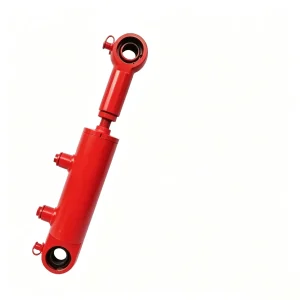
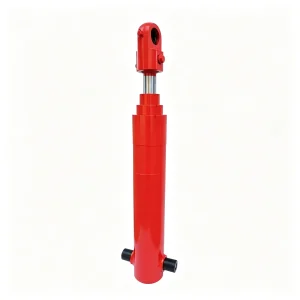
Refuse Truck Hoist Cylinder — 63 mm Bore, 385 mm Stroke for Full Body Tipping and Waste Discharge Operations
Rod: 40 mm
Stroke: 385 mm
Mounting: 670 mm
The refuse truck hoist cylinder — also referred to as the body tipping cylinder or ejector scraper cylinder in some vehicle designs — is the heaviest-duty hydraulic actuator in a refuse collection vehicle’s hydraulic system. With a 63 mm bore, a 40 mm high-strength rod, and a 385 mm stroke mounted at a 670 mm C-C distance, this cylinder generates the sustained hydraulic force and travel needed to either tilt the entire refuse body for rear discharge at a transfer station, or to drive the internal scraper panel that pushes compacted waste out of the body during ejection. It is the actuator on which the entire productivity of the refuse operation depends at discharge time.
Technical Specifications
| Cylinder Type | Body Hoist / Scraper Drive Cylinder (Double-Acting) |
| Bore Diameter | 63 mm |
| Rod Diameter | 40 mm |
| Stroke Length | 385 mm |
| Installation Distance (C-C) | 670 mm |
| Sollicitatie | Refuse Body Hoist / Ejector Scraper Drive |
Refuse Truck Hoist Cylinder Engineering: How 385 mm Stroke and 63 mm Bore Handle Full-Load Body Tipping and Ejection Forces
The hoist cylinder on a refuse vehicle is specified to perform two fundamentally different but equally demanding tasks depending on vehicle design. In tip-body refuse trucks — where the entire body tilts rearward on a sub-frame pivot to discharge waste at a transfer station — the hoist cylinder must lift the loaded body through a tipping arc while overcoming the full gravitational moment of the body plus waste payload. A 10 cubic meter body weighing 2,500 kg empty and loaded with 6,000–8,000 kg of compacted waste creates a tilting moment that, at the start of the tipping stroke when the cylinder is at its least favorable geometric angle, can require sustained cylinder forces of 60–90 kN depending on the body length and pivot geometry.
A 63 mm bore cylinder at 200 bar system pressure generates approximately 62 kN of push force — correctly matched to the lower end of this requirement. For heavier bodies or steeper tipping geometries, the cylinder operates at higher system pressures up to 250 bar, reaching approximately 78 kN. The 40 mm rod provides the column strength needed for the 385 mm extended length without rod buckling under the compressive load — the Euler critical load for a 40 mm rod at 385 mm unsupported length with one end pin-mounted and one end pin-guided exceeds 180 kN, providing a buckling safety factor of approximately 2.3× against the maximum working force — acceptable for a well-aligned cylinder installation.
In ejector-body refuse trucks — where the body does not tip but instead a hydraulically driven scraper panel traverses the full body length to push waste out the open rear door — the hoist cylinder drives the scraper through its full travel, requiring 385 mm of stroke precisely matched to the body’s internal scraper travel. The force requirement during ejection depends on the compaction ratio and the friction between the waste material and the body floor. With high-density compacted waste (densities of 400–600 kg/m³) and body floor friction coefficients of 0.3–0.5, the scraper drive force can reach 40–70 kN — again within the 63 mm bore’s capacity at standard system pressures.

Heavy-Duty Refuse Body Tipping Cylinder Construction: Rod Strength, Seal System, and 670 mm Mounting Distance Significance
The 40 mm rod on the hoist cylinder has a rod-to-bore ratio of 0.635 — meaningfully higher than the 0.55 ratio seen on many general-purpose industrial cylinders of comparable bore size. This elevated ratio is deliberate: the hoist cylinder frequently operates in conditions where the rod is exposed to side loading from body misalignment during tipping, or from scraper panel binding due to waste particle bridging in ejector-body applications. A larger rod diameter resists these side loads by increasing the rod’s cross-sectional moment of inertia, distributing the bending stress over a larger rod section and reducing deflection at the rod-end connection point.
The barrel is manufactured from seamless cold-drawn E355 tubing, precision honed to H8 tolerance, and the bore surface is protected from corrosion between production and installation by a water-soluble anti-rust oil that is fully miscible with the hydraulic oil it displaces during first fill. The barrel end caps are welded and subsequently pressure-tested — not threaded and removable, which would be a potential leak and corrosion site in a long-stroke cylinder exposed to external corrosion. Welded end cap construction provides a structurally superior joint that does not rely on thread engagement for pressure retention.
The 670 mm center-to-center mounting distance is critical for body tipping geometry: it positions the cylinder cap-end pivot on the vehicle sub-frame and the rod-end pivot on the body underframe at a distance that ensures the cylinder is operating near its most efficient force angle at the heaviest part of the tipping stroke — the initial 30–40 degrees of body rotation when the body’s weight moment arm is longest and the gravitational load on the cylinder is greatest. Subsequent degrees of rotation become progressively easier as the body’s center of mass moves toward vertical alignment with the pivot point, and the cylinder force demand drops accordingly. The 670 mm C-C mounting distance is engineered to match this load profile.
Service Life, Inspection Schedule, and Replacement Sourcing for Refuse Truck Hoist Cylinders in Municipal and Private Fleet Operations
The hoist cylinder is a low-cycle but high-load component: a typical refuse vehicle tips or ejects its load 2–4 times per shift, versus the hundreds of cycles per shift of the latch or swing cylinders. This low cycle count means fatigue is rarely the failure driver — instead, the primary failure modes are external rod seal leakage driven by physical rod damage (stone chips, direct impact in the sub-frame area, or corrosion pitting of the chrome surface), and barrel end-cap joint corrosion that eventually penetrates the welded seam in very long-service vehicles operating in aggressive salt environments.
Inspection of the hoist cylinder should be included in every major service interval — typically every 500–1,000 operating hours or annually. Key inspection items include: rod surface condition (any pitting, scoring, or chrome delamination that would compromise the rod seal), barrel weld seam condition for corrosion, pin bore condition at both clevis connections (inspect for oval wear that creates mechanical slop under load), and hydraulic port fitting condition. A cylinder showing rod surface damage should be replaced rather than resealed, as installing a new seal set on a damaged rod will result in premature seal failure within weeks of service return.
For municipal waste departments procuring replacement hoist cylinders through formal tender processes, we provide complete technical documentation packages including dimensional drawings to ISO 5457 format, material certification (EN 10204 3.1 mill certificates for barrel and rod materials), pressure test records, and surface coating specifications. Our quality management system is certified to ISO 9001:2015, and we can provide a copy of the relevant quality plan sections upon request for customers requiring supplier quality audit documentation. Volume pricing for framework supply agreements is available for contracts covering annual fleet replacement requirements across 12–36 month periods.
Typische toepassingen
- Rear-load compactor refuse trucks — body tip cylinder at transfer station discharge
- Ejector-body refuse vehicles — scraper panel drive cylinder (full body traverse)
- Roll-off container trucks — sub-frame body tipping actuator
- Bulk waste tipper trailers — hydraulic body hoist on 3-axle long-haul vehicles
- Stationary waste compactor ejector drives — fixed installation applications
- Recycling baler feed systems — bale ejection cylinder
Procure the Refuse Truck Hoist Cylinder — Certified Quality, Framework Contracts Available
Contact our sales team for formal tender documentation, material certification packages, dimensional drawings, and volume framework supply agreement pricing for municipal and commercial fleet programs.